Discovery gets a bad reputation when the clock is running. A large customer is threatening to walk. The roadmap locks on Friday. Sales has a seven figure deal in deal desk. An executive wants an answer before the next board meeting. Someone says: “We do not have time for discovery.”
Usually what they mean is that they do not have time for the version of discovery they have in their head. Weeks of interviews. A formal research plan. Synthesis workshops. A beautiful repository. A team disappearing into process while the business problem keeps burning. Fair enough.
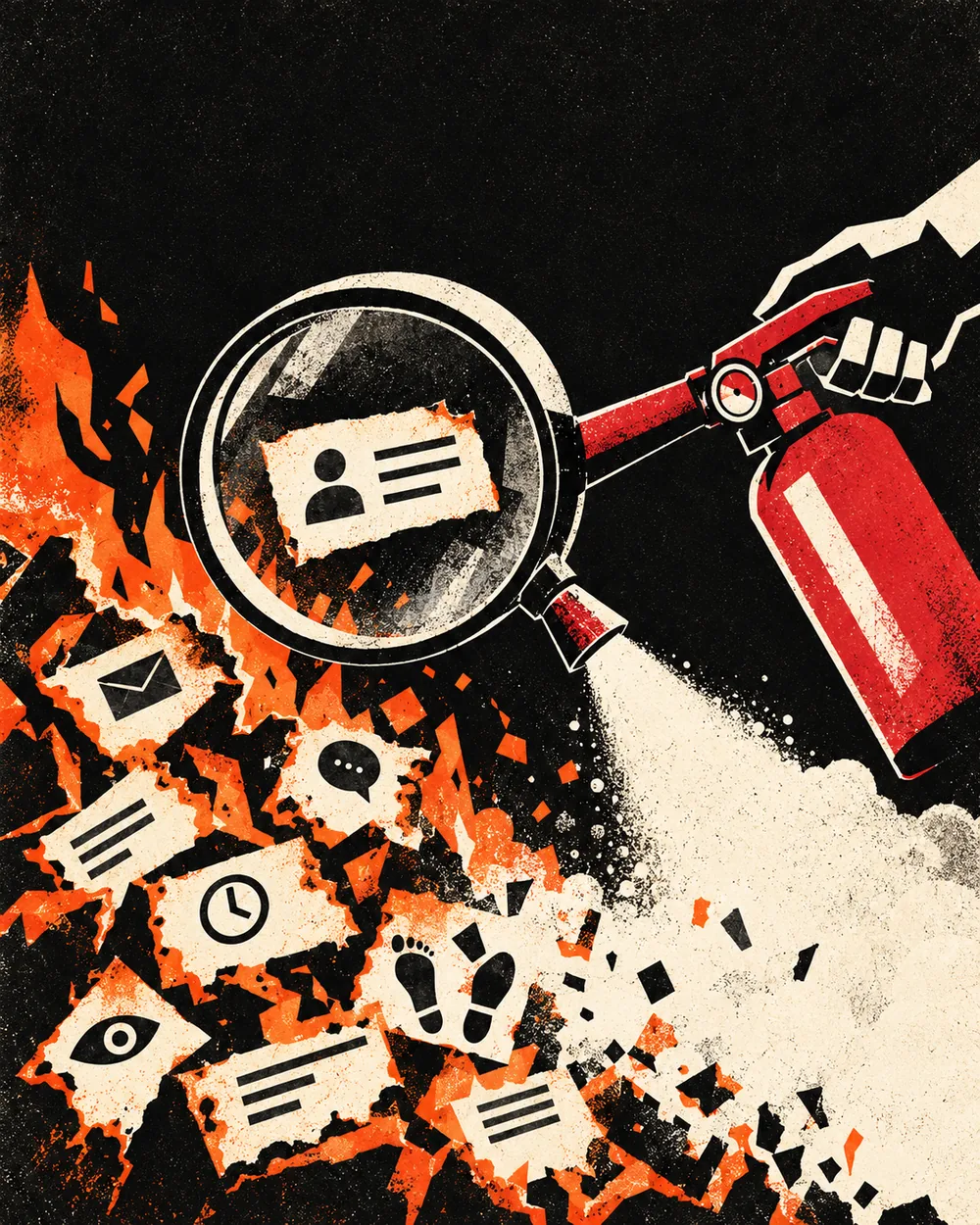
Sometimes you do not have time for that. But the alternative is not guessing. When time collapses, discovery should become forensic. Stop asking, “What research program would we ideally run?” Ask, “What evidence has this organization already generated that can tell us what is actually happening?”
That is a different posture.
The evidence is usually already lying around
Most urgent product problems are not appearing for the first time. Customers have been working around them. Support has been absorbing them. Sales has been explaining them. Operations has been compensating for them.
Analytics has probably been measuring pieces of them, even if nobody has connected the signals yet. The fastest useful discovery often starts by following that residue. Imagine a Fortune 500 prospect asking for a custom export because its audit team cannot get what it needs from your HR platform.
You could start scoping the export. Or you could reconstruct what happens today. Who needs the file? What are they trying to verify? Why can they not do it inside the product?
What do support tickets say? What permissions mistakes keep appearing during onboarding? Which other customers have built the same workaround? Does product telemetry show admins bouncing between roles, settings, and permission screens? Now you are doing discovery.
You are just not pretending that the only legitimate evidence comes from a new research study.
Workarounds are behavior
I pay close attention to workarounds because workarounds are behavior. A request is what someone says they want. A workaround shows you what they are already willing to do to get the job done. People export data into spreadsheets. They create side channels in Slack.
They keep private notes. They duplicate information in another system. They call Support for a task the product supposedly handles. They ask Sales to make promises because the formal workflow does not give them confidence. That is product evidence.
A workaround can reveal missing capability. It can also reveal that the apparent feature problem lives somewhere else. The customer asking for an export may have a permissions clarity problem. The executive asking for a churn dashboard may be seeing renewal risk too late to intervene.
The sales leader asking for a one off integration may be compensating for a broken onboarding process. The workaround gives you the thread. Pull it.
Triangulate. Do not wait for perfect evidence.
The mistake under pressure is searching for one source that will settle the argument. There usually is not one. Customer conversations can be biased. Sales notes can be selective. Support tickets overrepresent people frustrated enough to contact Support.
Telemetry shows behavior, not always intent. Contracts show what was promised, not necessarily what users need. Finance sees the economic consequence, not necessarily the workflow creating it. None of those sources is useless. None of them deserves to be treated as the whole truth either.
That is why triangulation matters. If Support says onboarding confusion is increasing, product data shows repeated permission changes, the prospect's audit team cannot explain who has access to what, and Sales keeps hearing requests for custom exports, the combined picture is much more useful than the export request by itself. Forensic discovery is about assembling enough of the scene to make the next decision responsibly.
Not certainty. Decision quality.
The evidence should match the consequence
Teams sometimes ask: “Did we do enough discovery?” As though there is one universal amount. There is not. A low risk copy change and a million dollar roadmap commitment should not require the same evidence.
A reversible experiment and a deeply integrated enterprise feature should not require the same confidence. When the decision is expensive, difficult to unwind, or likely to create precedent, demand more evidence. When the decision is cheap, observable, and easy to reverse, learn by doing.
The point is not whether the team completed the full discovery ritual. The point is whether the evidence is proportionate to the consequence of being wrong.
You need a stopping rule too
Discovery can become avoidance. There is always another customer you could interview, another dashboard you could inspect, another edge case you could explore. Under pressure, the PM needs to know when the evidence has moved from: “We are guessing.” to: “We understand enough to choose the next move.”
A useful stopping rule is something like this: We know who is failing. We know where the workflow fails. We have more than one source supporting the pattern. We understand the likely business consequence.
We can name the assumptions we are still making. And we have a next step that lets us learn without overcommitting. That is enough to move. Not enough to know everything. Enough to make the next decision without pretending the first request was the only evidence available.
Speed should change the method, not erase the discipline
I do not believe product teams need to earn the right to make a decision by performing discovery theater. I also do not believe urgency grants permission to abandon product judgment. Those are two versions of the same mistake: confusing the process with the purpose.
The purpose of discovery is to reduce the chance that we confidently solve the wrong problem. Sometimes that means interviews next week. Sometimes it means watching users today. Sometimes it means reading thirty support tickets, checking telemetry, calling the account team, looking at the contract, and tracing the workaround before lunch.
When the room says, “We do not have time for discovery,” do not defend the ritual. Change the shape of the work. The scene already contains evidence. Go find it.