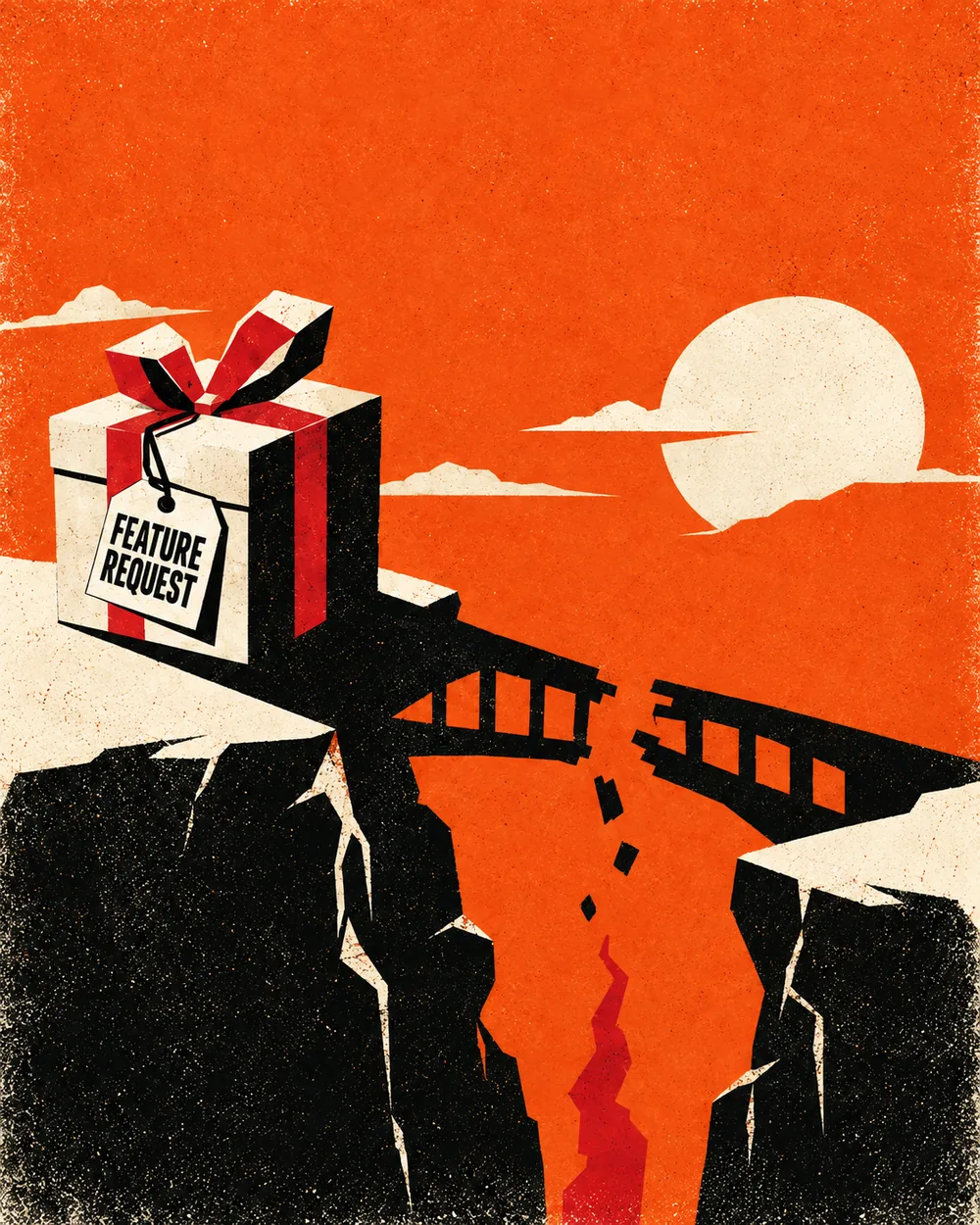
A senior stakeholder walks into the room with a problem, except it does not sound like a problem. It sounds like a feature. Customer Success is missing renewals. Millions in revenue are exposed. The team is “flying blind,” and the VP wants a churn dashboard in two sprints. The request is specific, urgent, and attached to a real business consequence.
That is exactly what makes it dangerous. When the pain is credible, product teams tend to give the proposed solution credibility by association. The conversation jumps to scope, dates, engineering capacity, data, and what should appear on the dashboard. Before anyone notices, an executive hypothesis has become a product commitment. The pain may be real.
The feature is still only a hypothesis. A feature request is evidence that somebody needs something to change. It is not proof of what needs to be built.
The proxy problem trap
I call this the proxy problem trap. A dashboard, report, integration, export, workflow, or AI assistant gets named under pressure. Because everyone can point at the thing, the thing becomes the problem. “We do not have a dashboard.” “We need an export.”
“We need an integration.” “We need an AI copilot.” Those statements are easy to plan against. They are also downstream statements. They tell you what someone believes would help, not what is actually failing. Go back to the churn dashboard.
Customer Success may genuinely lack visibility. But visibility into what? Which customers? At what point in the renewal cycle? What decision would better information change? Are the underlying signals trustworthy? Does the account team have enough time to act once the signal appears? Maybe the failure is detection. Maybe it is intervention.
Maybe nobody owns the handoff. Maybe the data is bad. If you build the dashboard before answering those questions, you have not eliminated uncertainty. You have hidden it inside a feature. That is how smart teams ship the wrong thing on time.
Urgency does not make the first answer correct
The harder version of product management rarely happens when everyone is calm. It happens when a large account is threatening to leave. When revenue is at risk. When the roadmap locks next week. When an executive's credibility is attached to the outcome. Under those conditions, questioning the request can feel bureaucratic. Nobody wants to be the PM who responds to “we are losing customers” with “give us six weeks for discovery.”
But that is a false choice. You do not have to choose between blindly building the request and disappearing into research. You can honor the urgency without accepting the diagnosis. That is the move. The stakeholder can be completely right about the pain and still be wrong about the solution. They may even be right about both. Product management earns its keep by refusing to treat those as the same claim.
The PM is not there to win an argument
This is also why the answer should not automatically be: “No, we should not build a dashboard.” Now you have simply replaced one opinion with another. The better product move is to change the question the room is answering. Instead of: “How fast can we build the dashboard?”
Try: “What decision are we currently unable to make?” “Who needs to make it?” “What happens today because they cannot?” “Where in the renewal workflow are we actually losing the customer?”
“What would need to become true for the revenue outcome to improve?” Those questions preserve the business problem while reopening the solution space. Maybe the answer is still a dashboard. Maybe it is an alert. Maybe the data foundation is so unreliable that a dashboard would create false confidence.
Maybe Customer Success already has the information but gets it too late to intervene. Maybe the account team needs one signal inside the tool it already uses. The point is not to prove the stakeholder wrong. The point is to keep the organization from committing to an answer before it has established what “right” means.
Requests are valuable evidence
None of this means feature requests are bad. They are useful precisely because somebody cared enough about the pain to invent a solution. A request may reveal a workaround, a missing decision, an unmet need, a trust problem, or a gap between how the organization thinks work happens and how it actually happens.
The mistake is treating the request as the end of discovery instead of the beginning. This matters with customers too. If an enterprise client asks for a custom export, the export itself may not be the job. They may be struggling with permissions, auditability, internal approvals, or trust in the system. Building the export can make the customer temporarily happier while leaving the underlying failure untouched.
A feature request can be an accurate description of pain wrapped in an inaccurate theory of change. Product managers need to separate the two.
Preserve the pain. Reopen the solution.
There is a simple standard I like for these moments:
Do not dilute the urgency. Do not inherit the solution.
If $2.4 million in revenue is at risk, keep $2.4 million in revenue on the board. If Customer Success is missing the intervention window, keep that failure visible. If a customer cannot complete an audit, keep the audit problem intact.
What you reopen is the assumption about what must be built. That is not obstruction. That is product management. The easiest version of the job is receiving a request and turning it into software. The more valuable version is understanding why the request exists, what outcome is actually failing, and whether the proposed feature is the best available way to change it.
The difference can look small in a meeting. One team hears: “Build a dashboard.” The other hears: “Something important is broken. Let’s find out what.”
That difference is where a lot of product judgment begins.