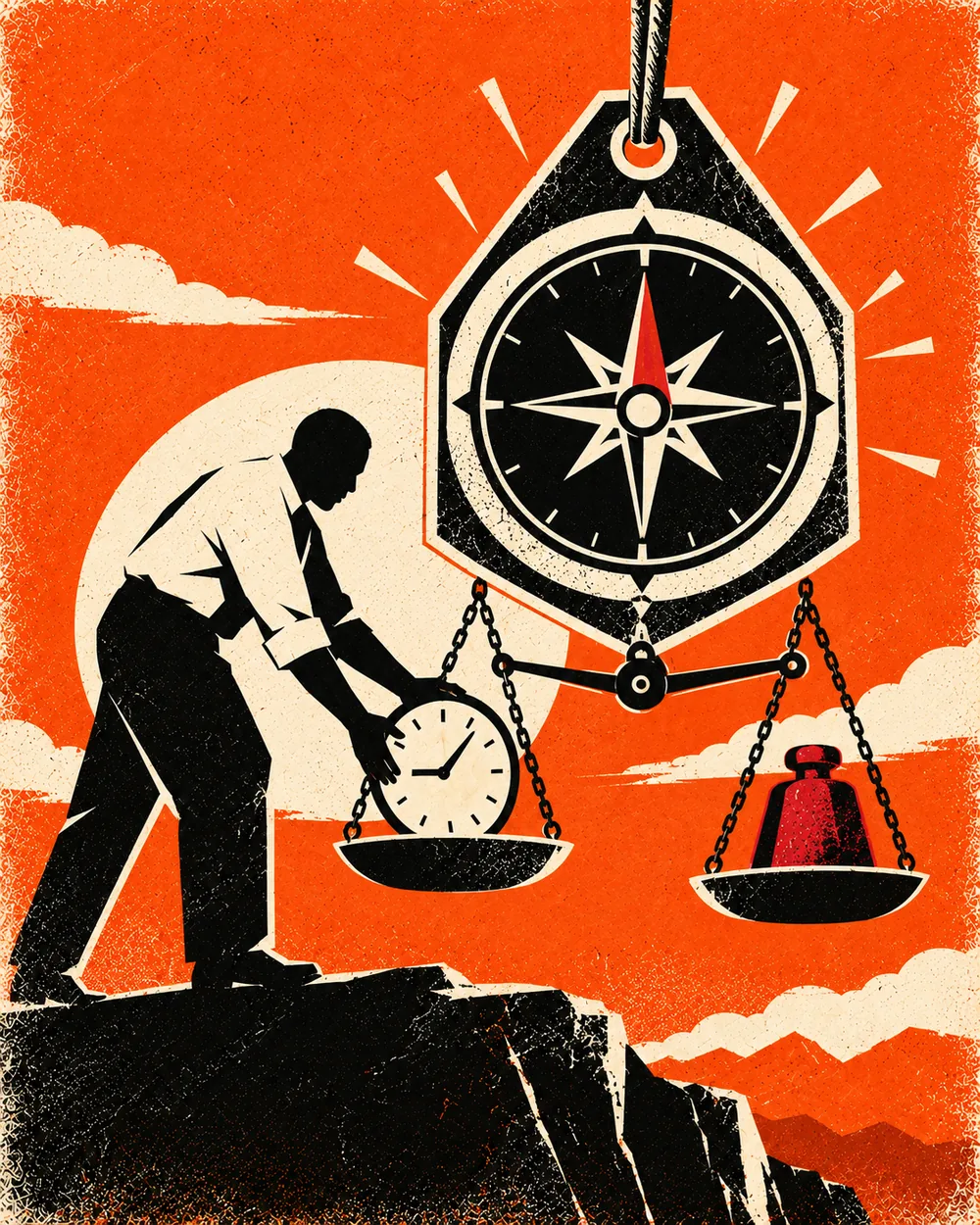
A lot of product principles sound good because they are hard to disagree with. Start with the customer. Keep it simple. Move fast. Think long term. Deliver value. Great. Now two competent teams disagree about two legitimate options. Which one loses? If the principle cannot help answer that question, it may be a value. It may be an aspiration. It may be good advice. But it is not doing much decision work. A useful product principle should cost you something.
Principles are predecisions
I think of a strong principle as a choice the organization makes before the pressure arrives. Not a complete decision. A default. It says: When this recurring tension appears, we generally prefer this side, even though the other side has real value. That last part is important. If nobody reasonable would argue for the alternative, there is no tradeoff. “Do not intentionally harm customers” is a value boundary. “Prefer shared capability over another standalone application, even when the standalone application could ship faster” is a product principle.
Now there is something to debate. Speed matters. Local ownership matters. Portfolio coherence matters too. The principle establishes the starting position when those values collide.
The cost is the proof
One of the principles I pushed in a large store product environment was essentially: no new applications by default. That did not mean a literal universal ban on creating software. The problem was fragmentation. Every local product need could justify another surface. Another application could be the fastest way for one team to get something into associates’ hands. Locally, that could be rational. Across the ecosystem, the cost showed up as more navigation, duplicated capabilities, inconsistent experiences, more maintenance, and more things an associate had to understand.
So the principle created a default: Before creating another standalone application, look for a service, shared capability, or existing surface that can carry the need. Sometimes that meant the locally faster option lost. That is what made the principle real. It had an accepted cost.
A useful principle contains a tension
You can test almost any product principle by forcing it into a conflict. Instead of: “Keep it simple.” Try: “When flexibility and simplicity conflict for the primary workflow, we generally choose simplicity, even if advanced users need a secondary path.” Instead of: “Think long term.” Try: “When short term revenue requires a one off capability that creates permanent platform complexity, we generally protect the shared model, even if that means losing some near term revenue.”
Now the language may still need work. But at least the organization can see the trade. The pattern is: There is a recurring tension. There is a default preference. There is a cost we knowingly accept. That is much more useful than a sentence everybody applauds.
Principles distribute judgment
Product principles become especially valuable at scale for exactly this reason. A senior leader cannot be in every decision. They should not be. If every team has to escalate the same class of tradeoff, the organization is learning nothing. A principle lets the reasoning travel. Not the answer to every situation. The reasoning. A team can say, “Our default is to protect the shared platform, but this case is different because the customer commitment is temporary, the capability is reversible, and the revenue funds the migration path.”
Good. Now the exception is legible. The principle did not eliminate judgment. It gave judgment a starting point.
Another useful test is whether the principle changes ordinary planning decisions before conflict has to escalate. If teams still need an executive to arbitrate the same trade every time, the principle has not really distributed much judgment. The cost should show up in normal work: a faster local launch waits, a deal gets a different solution, or a roadmap item loses because the organization already chose the other side of the trade.
The danger is doctrine
Principles can go bad in exactly the same way. A leader writes a strong principle in one context. The company changes. The market changes. The architecture changes. The principle survives because it sounds wise. Now people use it to shut down arguments instead of improve them. “We do not build new apps.” Conversation over. That is not the goal. A principle should make exceptions explainable, not impossible. If the context has changed enough that the accepted cost is no longer worth paying, revisit the principle.
Defaults are useful because they reduce repeated debate. They become dangerous when they hide new evidence.
Strategy is bigger than a principle
A principle is not strategy either. It does not diagnose the most important challenge facing the business. It does not tell you where to compete. It does not allocate capital across the portfolio. It helps recurring execution choices stay coherent with a broader direction. That is enough. Trying to make principles do everything usually turns them back into vague slogans.
Make the principle pick a loser
Take one of your product principles this week. Finish this sentence:
When X and Y conflict, we generally choose X, even though it costs us _____.
If you cannot fill in the blank, ask whether the statement is actually helping teams decide anything. A good principle should make a reasonable person uncomfortable sometimes. It should cause a good option to lose because the organization already decided which tradeoff it wants to make repeatedly. That is the point. If your principles never cost you anything, they may not be principles yet.