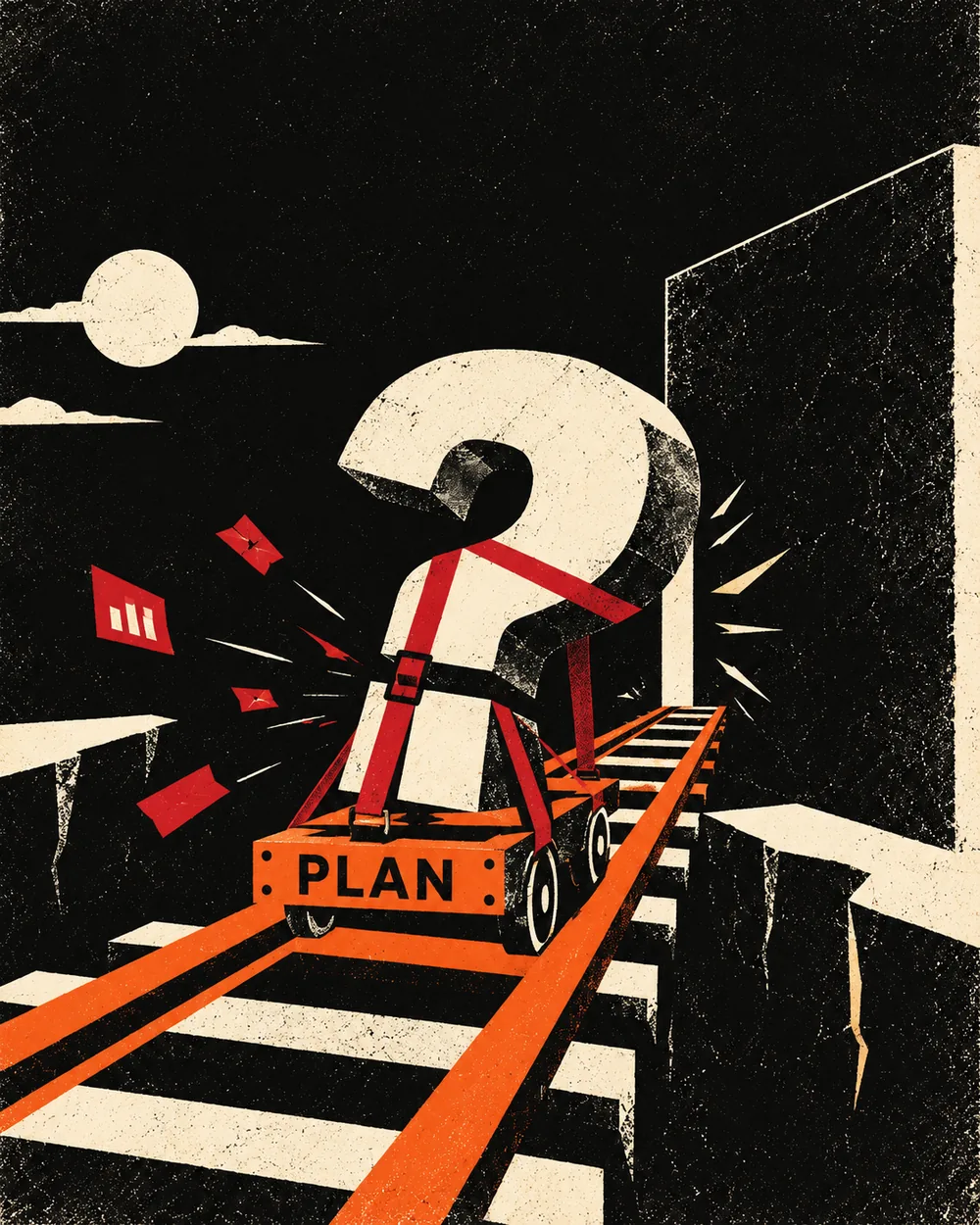
Some work exists to deliver what you already decided. Other work exists to figure out whether you should decide at all. Product teams get into trouble when they govern both the same way. A learning bet gets a roadmap date, a fixed scope, and a delivery plan. Suddenly the team is rewarded for completing the experiment instead of changing its mind when the evidence says it should. An execution commitment gets treated like open ended discovery. The team keeps exploring while customers, operations, or another part of the business is already depending on the thing to happen.
Both can look like product work. They are not the same job.
Learning work is supposed to threaten the plan
The purpose of learning work is to reduce uncertainty before you make an expensive commitment. That means the work should be capable of producing an answer you do not like. If the experiment cannot change the decision, it is probably not an experiment. It is validation theater. A useful learning bet starts with a dangerous assumption. Can this technology detect the condition accurately enough to be useful? Will customers change behavior if we remove this step?
Can the operation absorb the new workflow? Will the economics still work at the scale we care about? Then you ask what evidence would meaningfully raise or lower confidence. The deliverable is not the prototype. The deliverable is a better decision.
Execution work has a different obligation
Once the organization has made a real commitment, the questions change. What exactly are we promising? Who owns each dependency? What must be true for launch? What can move and what cannot? Where are the operational, legal, security, financial, or customer readiness risks? What happens if we miss? Execution work still contains learning. Reality never stops surprising you. But the center of gravity changes. You are no longer trying to decide whether to make the commitment. You are trying to fulfill it responsibly.
That distinction matters because the governance should change with it.
A prototype can be successful because it killed the idea
Organizations often get emotionally confused here. A team spends six weeks building a prototype. It runs a field test. The evidence says the underlying assumption was wrong. Leadership calls the effort a failure because the prototype did not become a funded product. I would call that a potentially excellent result. The team spent six weeks preventing a twelve month mistake. That is exactly what learning work is for.
The problem comes when the organization quietly converts every learning bet into an implied promise. The moment a prototype appears in a leadership review, people start asking when it ships. The moment a customer touches it, Sales starts talking about availability. The moment a team receives funding, continuation begins to feel like success. Now the experiment has a constituency. Stopping becomes harder than learning.
The mode can change
I saw this shape in work on On Shelf Availability, where we were using computer vision and store workflows to help identify when products were not where customers expected them to be. Early work had to answer feasibility questions. Could the signal be trusted? Could it be turned into something useful for associates? Could the operating model respond to the information quickly enough for the technology to matter? Those are learning questions. The work needed evidence, thresholds, field observation, and enough technical reality to know whether the opportunity deserved more capital.
Once the direction became a funded commitment, the work changed. Now there were integrations, rollout decisions, operating dependencies, adoption questions, field readiness, support, and accountability. The same initiative moved from learning toward execution. That does not mean discovery ended on Tuesday and delivery began on Wednesday. It means the dominant question changed. Before commitment: Should we make this bet, and under what conditions? After commitment: How do we deliver the bet we made without pretending the remaining risks disappeared?
Do not use “discovery” to avoid commitment
There is an opposite failure too. Teams can hide inside learning forever. One more interview. One more prototype. One more experiment. One more round of stakeholder input. Sometimes the uncertainty has been reduced enough and the real issue is that nobody wants to own the decision. Learning work needs a stopping rule just as much as execution work needs a readiness standard. What assumption are we testing? What evidence would be enough to move?
What evidence would make us stop? When will we decide? Without those questions, “discovery” can become a polite name for indecision.
Do not use “delivery” to protect a bad commitment
Execution discipline should not become stubbornness either. A commitment was made with the evidence available at the time. New evidence can still make the original decision wrong. The answer is not to pretend every commitment is reversible with no consequence. Some are not. Customers may be depending on you. Capital may already be deployed. Facilities may be opening. Contracts may exist. But responsible execution includes escalation when the premise changes materially.
The difference is that you now have to account for the cost of changing course, not merely the attractiveness of a new idea.
Ask what the work is trying to accomplish
Plans are useful. Roadmaps are useful. Experiments are useful. The mistake is forcing every kind of uncertainty through the same operating machinery. If the work exists to learn, govern it around the assumption, the evidence, the threshold, and the decision it should change. If the work exists to execute, govern it around the commitment, the scope, the dependencies, the readiness, and the consequence of missing. And when the work changes modes, say so explicitly.
A learning bet should be allowed to teach you not to build. An execution plan should be strong enough to carry a promise. If you cannot tell which one you are running, the team may be optimizing for the wrong definition of success.