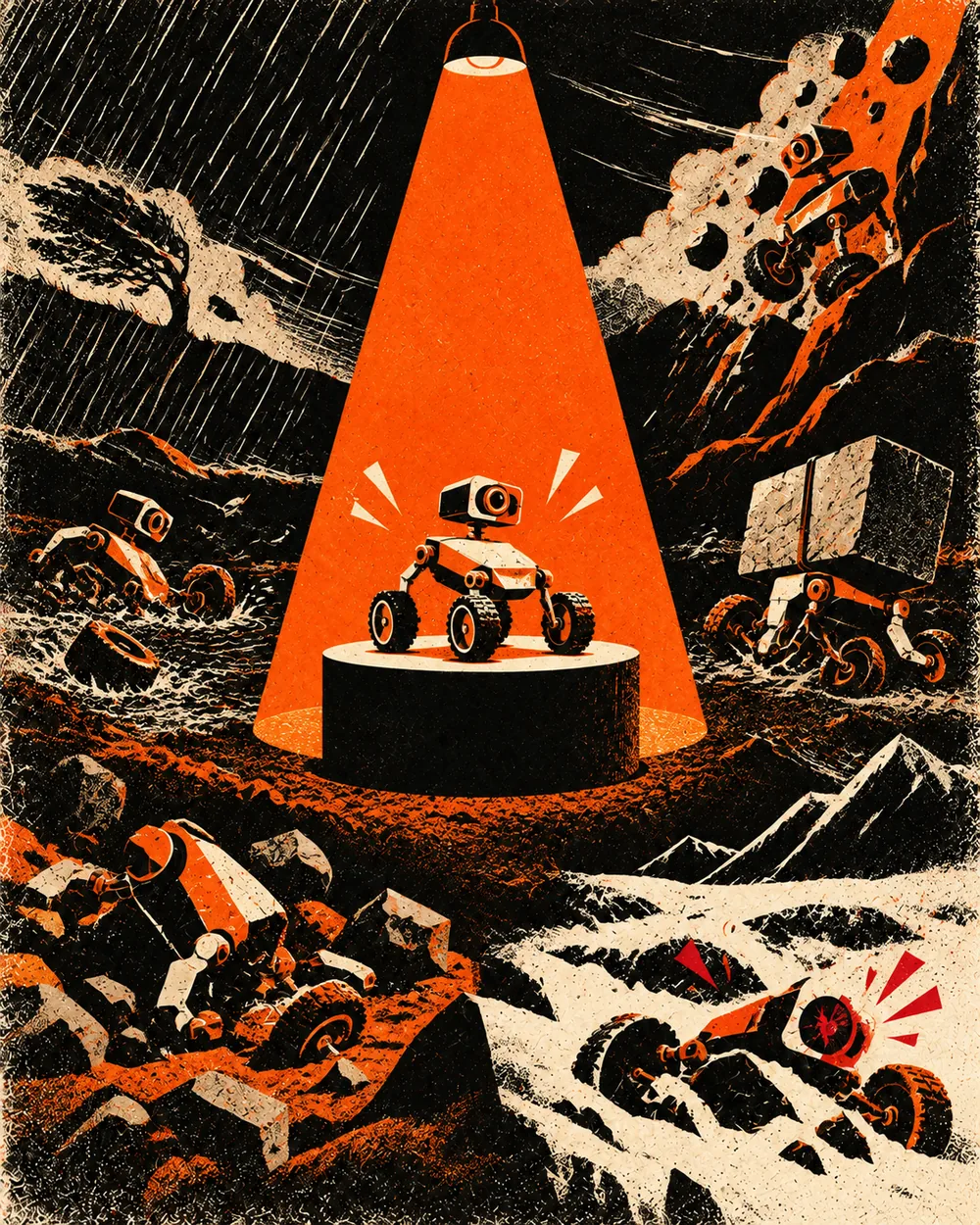
AI demos create a particular kind of confidence problem. A team can show a model summarizing feedback, an agent completing a workflow, or an assistant answering a difficult question, and suddenly everyone can see the idea instead of debating it in the abstract. That is useful. The confusion starts when evidence that was good enough to say this is worth exploring gets carried forward as evidence that we know this AI works reliably.
The kind of demo I mean here is specific: the team is showing the AI capability itself under selected conditions. This is not a sales demo or a routine sprint-status demo. The goal is to make the behavior concrete enough to learn from it. Once the organization starts making a bigger claim about that behavior, the evidence has to get bigger too.
An AI demo answers a narrower question
Early in development, a small set of examples can be exactly what the team needs. Can the model summarize this kind of document? Can the agent complete the basic workflow? Does the interaction make sense to the people who would use it? Does the output look useful enough to justify more work?
Those are legitimate Product questions. A handful of carefully reviewed examples may be enough to answer them. The problem is not the demo. The problem is forgetting which question the demo answered.
There is a meaningful jump between we saw the AI do something useful and we have enough evidence to trust this behavior across the conditions that matter. That second statement is where evals enter the Product conversation.
Evals make “good” explicit
An eval is a repeatable way to check whether an AI system is doing the job well enough across a meaningful set of cases. The implementation can get technical, but the first Product question is plain: what does good AI output look like for this use case, and what kinds of failure would change our decision?
For an AI system that summarizes customer or employee feedback, “good” might mean that it preserves the dominant themes without erasing an important minority issue, separates different kinds of problems instead of blending them together, and does not invent numerical certainty the evidence cannot support. A policy assistant has a different standard. So does an agent that can move money, change permissions, or take an action on somebody's behalf.
Engineering, Data, or ML partners can build the harness and help measure performance. Product still has to help define what behavior matters, what failure carries consequence, and what evidence is enough for the next decision.
I ran into this when the audience changed
I saw a version of this in Experience Measurement. At first, individual balanced teams could work through their own associate feedback, build their own readouts, and explain what they were seeing in weekly stakeholder conversations. The people closest to the work had context around the comments, the product, and the operating environment, so AI-assisted synthesis could be useful without pretending the output was some universal source of truth.
The problem changed once I started aggregating feedback across teams, standardizing the analysis, and using that synthesis to support director- and VP-level conversations. Now the output had to hold together across a much larger body of evidence. Different runs could organize themes differently, and some numerical analysis was more reliable outside the model entirely.
At that point, the themes look reasonable was no longer a strong enough standard. The AI was becoming part of a centralized evidence process leaders would rely on to decide where to focus attention. That required much more explicit acceptance criteria, representative examples, human validation, and repeatable checks on whether the output was behaving the way the process needed it to behave.
The AI did not suddenly become worse. The consequence of being wrong became larger.
Start with the failure that would change the Product decision
“How accurate is the AI?” is usually too vague on its own. Accurate at what? A summary can read well while omitting the one issue leadership needed to see. A support assistant can answer most questions correctly and still invent a policy in the cases where being wrong is expensive. A routing system can look strong overall while repeatedly failing for one segment the business cares about most.
A useful eval starts with the Product consequence. What failure would make us narrow the use case, redesign the experience, add human review, delay broader rollout, or stop the system from taking an action? Once the consequence is clear, the evaluation can focus on the behavior that actually matters instead of chasing a generic accuracy number.
Representative cases matter more than impressive cases
An AI demo normally shows cases the team selected. An eval has to represent more of the cases the real world will select.
That means normal inputs, but it also means messy ones: incomplete context, unusual formats, important customer segments, conflicting instructions, edge cases, and situations where the cost of being wrong is higher than average. The goal is not to predict every weird thing that could ever happen. It is to make sure the evaluation covers the conditions that are important enough to change the Product decision.
That is also why one aggregate score can be misleading. A system can perform extremely well overall and fail badly in a small high-consequence category. Another can be slightly less consistent overall but fail in ways that are obvious, reversible, and easy for a person to correct. The score matters, but the shape of the failures matters just as much.
The evidence burden should follow the consequence
A rough AI prototype does not need the same eval program as a production capability that communicates policy, handles sensitive data, moves money, or acts without a person reviewing every step. As the claim gets stronger and the consequence gets larger, the evidence should become more deliberate: broader representative cases, clearer failure criteria, better instrumentation, explicit fallback behavior, and stronger controls around uncertainty.
That is not an argument for waiting until the team has mathematical certainty. Product has always made decisions under uncertainty. The standard is more practical: do not ask the organization to place more confidence in the AI than the evidence can support.
And the eval should keep learning after launch. Production will expose failure shapes the team did not anticipate. Customer complaints, human corrections, expert overrides, and new workflows can all become future test cases. The evaluation changes as the Product understanding changes.
Keep the demo. Be precise about what it proved.
AI demos are valuable. They make emerging capabilities understandable and give teams something real to react to. When the AI does something useful, celebrate it.
Then ask the next question with the right evidence standard. Did the demo show enough promise to keep exploring? Do we now have evidence that the AI behaves reliably across the conditions that matter for this use case? Do we understand the failures well enough for the consequence involved?
The AI demo worked. Good. Now make sure the confidence you place in it is no bigger than the evidence underneath it.