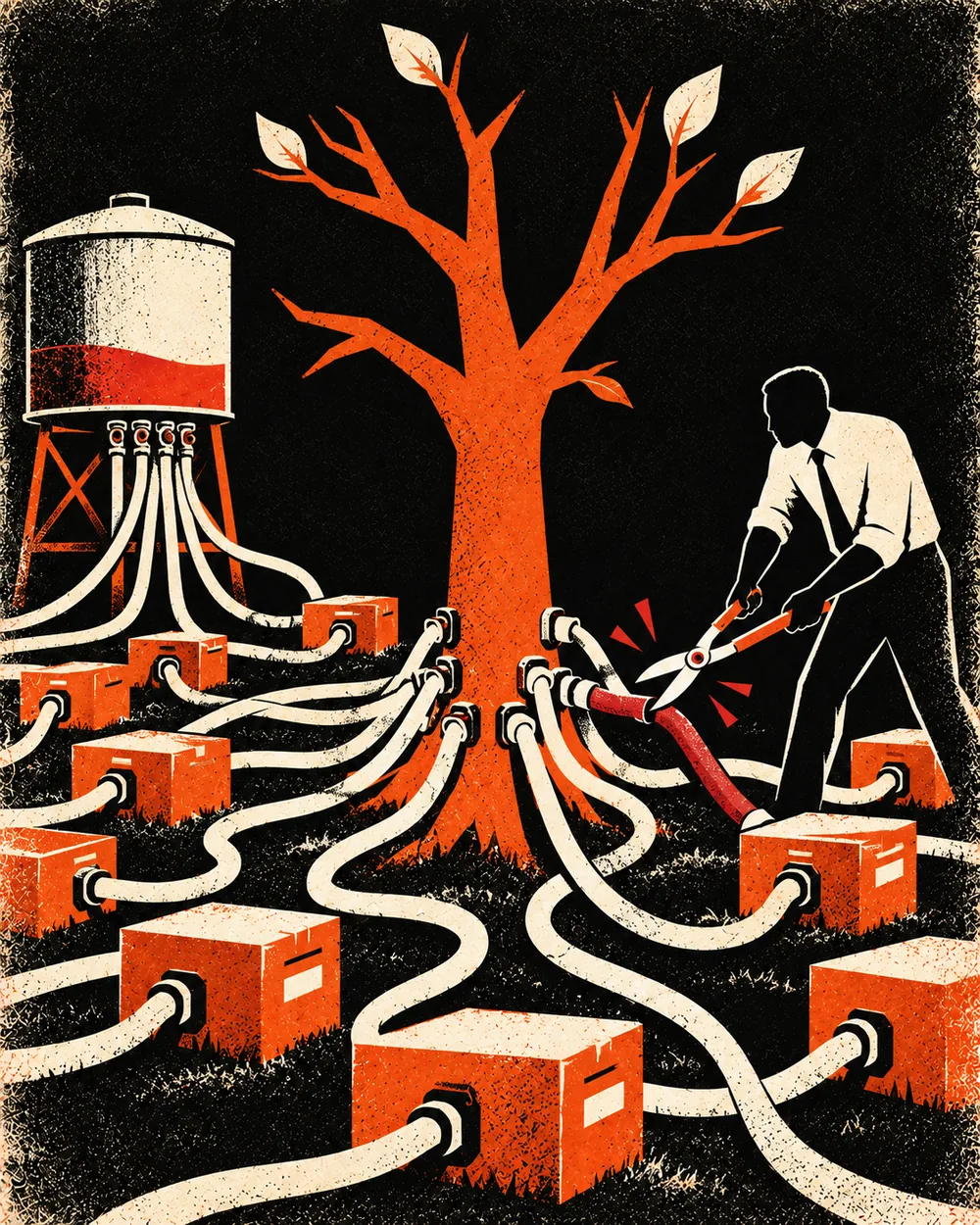
Companies are very good at adding things to the strategy. A new growth priority, an AI initiative, platform modernization, another customer segment, a new operating model. There is always room for one more important thing on the slide.
The budget, talent, and executive attention do not expand the same way.
That is why I do not learn much about a strategy by looking only at what the company says it will do. I want to know what receives less because the strategy exists. If nothing does, I am suspicious.
Priorities without deprivation are wishes
Leadership teams love the word “priority” because it sounds decisive without requiring a sacrifice. You can have five strategic priorities. Then seven. Then twelve. Every initiative is “important.”
Every legacy product still gets enough money to survive. Every executive keeps their team. Every roadmap stays partially alive. This is how an organization ends up with a portfolio that looks ambitious and behaves exhausted.
That is peanut butter spreading: taking a finite amount of capacity and forcing it across so much surface area that everything gets a thin layer and almost nothing gets enough weight to win. Push it far enough and you start damaging the thing you were trying to cover.
The strategy becomes additive because subtraction is politically expensive.
Stopping feels like failure
There are good reasons organizations resist stopping. A legacy product still produces revenue. People built careers around it. Customers depend on it. Teams spent years creating it.
A senior leader sponsored it. The company may have invested tens of millions of dollars already. The future bet, by comparison, is uncertain. That creates a psychological asymmetry. The old product is real.
Its revenue is in the forecast. Its customers can call you. Its employees know how to operate it. The new platform exists partly in models, research, architecture diagrams, and assumptions about future value. So the organization keeps both.
Then it keeps the next thing too. Eventually strategy becomes less about choosing a direction and more about protecting every historical constituency while trying to add a future on top.
Continuation is also a capital decision
This is the sentence I want leaders to internalize:
Keeping something alive is a decision.
It is easy to treat an existing product as the baseline and scrutinize only new investment. The new initiative has to prove ROI. The legacy line simply continues because it existed last year. That is backwards. Every budget cycle is an opportunity to ask whether the next dollar still belongs there.
Sunk cost can explain how you got here. It cannot justify the next investment. The team you keep assigned to a mature product is a team not building the next platform. The cloud budget keeping an unprofitable service alive is budget unavailable elsewhere.
Executive attention spent defending an old line is attention not spent on the new bet. Doing nothing is still allocation.
Strategy needs concentration
Some strategic bets require enough weight behind them to change the company. Platform modernization is not a hobby. Entering a new market is not a side project. Changing a core business model while preserving every existing operating assumption is usually fantasy.
If the company says an initiative is strategic, the resource pattern should look different. More of the right talent. Enough time. Clear leadership attention. Fewer competing priorities.
The willingness to remove blockers that matter. And often, less investment somewhere else. This does not mean every strategy requires killing a product. It means strategy should alter the distribution of scarce resources. Otherwise the organization has a narrative, not a choice.
The stop list is as strategic as the roadmap
Product organizations spend enormous effort creating roadmaps. I would like to see more stop lists. What are we no longer building? Which capabilities are entering maintenance only? Which customers will we stop customizing for?
Which experiments are not earning another quarter? Which products are being sunset? Which segments are no longer strategic? Which meetings, reports, and internal processes stop because the new operating model makes them unnecessary? What will leadership allow to become worse temporarily so the strategic bet can become materially better?
That is not pessimistic planning. That is focus.
Stopping requires a narrative too
One reason leaders keep everything alive is that subtraction is hard to explain. “We are launching three exciting new things” feels better than: “We are shifting capital away from two products people spent ten years building.” But if the strategy is real, leadership has to tell both halves.
Where are we going? Why can we win there? Why now? What are we leaving behind? How will we protect customers and employees through the transition?
What does success look like? A strategy that cannot explain its own sacrifice will struggle when the political cost arrives. Because the people losing budget will absolutely have a story. Leadership needs a stronger one.
Show me the funding change
The next time someone presents a strategy, ask one uncomfortable question:
“What receives less because we believe this?”
If the answer is vague, keep asking. Maybe the tradeoff is not money. Maybe it is talent. Maybe it is roadmap space. Maybe it is executive attention.
Maybe one market waits another year. Maybe a profitable but strategically weak product enters a managed sunset. The specific answer will vary. The principle does not. Strategy is not the list of things the organization says are important.
Strategy is the pattern of choices that determines where scarce resources go. And you can often see that pattern most clearly by looking at what the company is finally willing to stop funding.