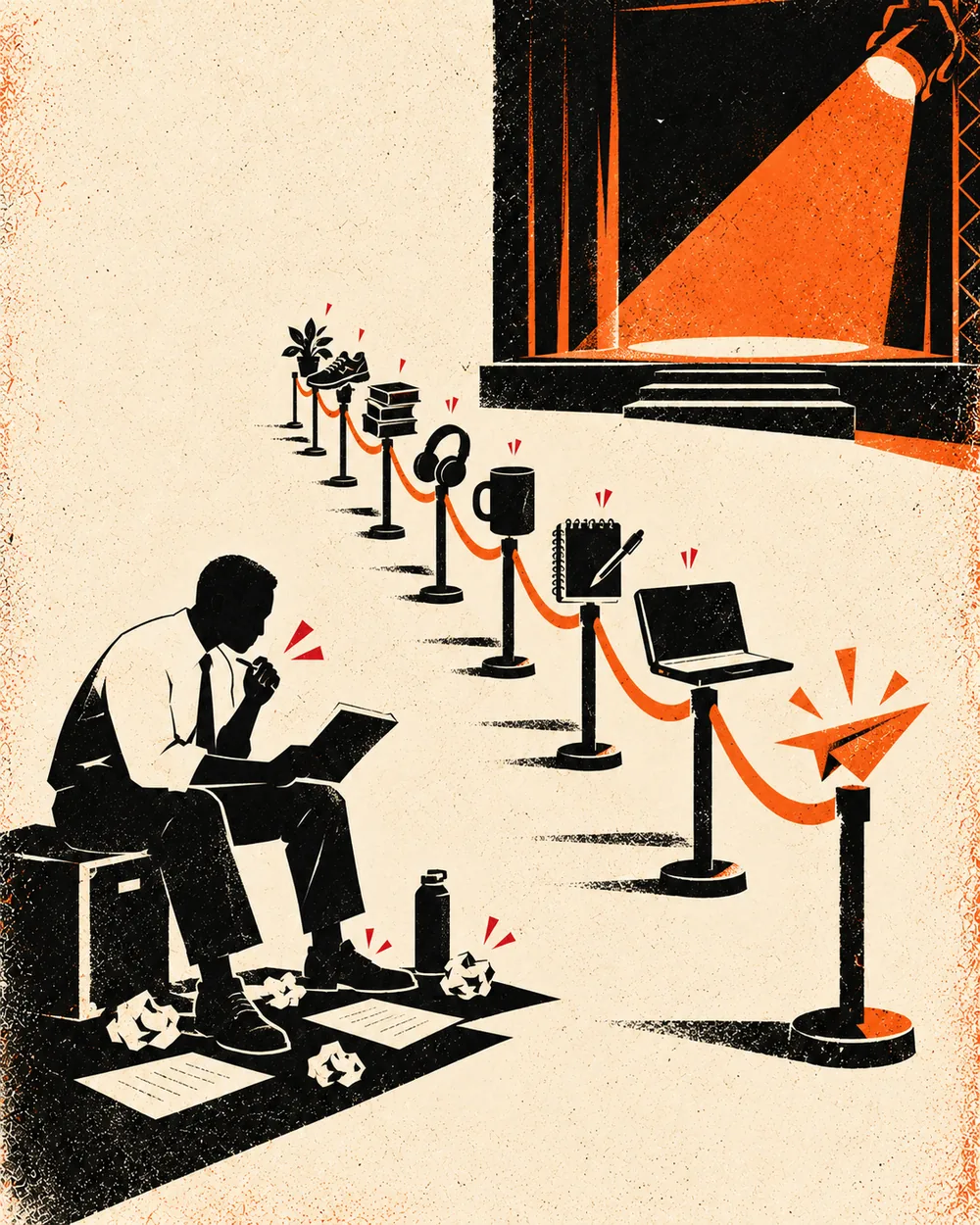
Product people talk about storytelling like it belongs to the big moments: the executive review, the funding pitch, the quarterly business review, the meeting where somebody suddenly cares whether the story is clear.
That is a rough time to start building the skill. The big presentation does not create your storytelling habits. It exposes the habits you have been building through ordinary Product work. If the evidence is scattered, the tradeoff was never written down, and nobody can explain what changed because of the work, three days of slide polishing will not fix the underlying problem.
Storytelling gets easier when the story has been forming while the work is happening.
Most Product storytelling happens nowhere near a stage
A roadmap conversation is storytelling. So is explaining why scope changed, walking through research with a partner, connecting a metric to a customer consequence, asking leadership to make a tradeoff, or telling an engineering team why a decision changed after new evidence arrived.
Those moments do not need a dramatic narrative arc. They need clarity. Can you establish enough context without burying the point? Can you separate what happened from what you think caused it? Can you make the tradeoff visible? Can you explain why the outcome matters to the person in front of you?
That is the practice. One reason I care about this is that I watched a team get better at it over time. When I was leading a team, I introduced a quarterly presentation practice—not because I needed another recurring deck, but because I wanted people to get better at connecting the work they had done to the value it created.
At first, the exercise exposed a predictable problem: too much of the story had to be reconstructed at the end.
If presentation week feels like archaeology, the problem started earlier
When people wait until the quarter is over to explain the quarter, they start digging. Which decision mattered? Where is that screenshot? What was the baseline? Why did we change direction? What did the research actually change? Which metric moved, and what did we believe caused it?
That is exhausting because the team is trying to rebuild context that was obvious three months ago and is now spread across tickets, decks, messages, research notes, dashboards, and memory.
The goal of a recurring storytelling practice should not be to make people better at surviving that scramble. It should change the behavior upstream. Over time, that is what happened. People began preserving evidence while the work was happening. Screenshots went somewhere useful. Decisions had context attached to them. Before states were easier to find. The team got better at separating an artifact from the impact the artifact was supposed to create. Collaboration happened before the presentation deadline because people knew they would eventually need to explain the work as a coherent sequence.
The presentation became easier because the Product thinking became easier to retrieve.
The forcing function is not the lesson
The quarterly cadence was a forcing function, not a management recipe. “Make your team present every quarter” is not the lesson. A recurring practice only develops people when the environment is actually developmental. If the manager turns it into a surprise inspection, a public performance test, an extra week of work piled on top of everything else, or a way to collect evidence against people, the same calendar event teaches something very different.
People need to understand what they are practicing and why, and they need coaching while they build the skill. They also need enough room to show where the story is weak without believing that every rough edge will become performance evidence. The goal is not polish for its own sake. It is better judgment made legible.
That distinction matters because Product storytelling can become performative very quickly. A charismatic person can make an ordinary result sound exceptional. A beautiful deck can make a weak causal claim feel certain. A clean narrative can erase the ambiguity that should actually change the decision.
Better storytelling should increase fidelity, not replace it.
Practice changes what you notice
Once you know you will eventually need to explain why the work mattered, you start noticing different things while you are doing it. You notice whether there is a meaningful before state. You notice when the team makes a tradeoff worth preserving. You notice when a metric moves but the causal story is still weak. You notice that the research did not merely produce a document; it changed a decision. You notice that the audience for the work may care about a business consequence that never appears in the design artifact.
Regular use matters more than waiting for the big presentation. Product work gives you chances to practice constantly: a five-minute update, a customer readout, a planning conversation, an email explaining why the forecast changed, a quick conversation with a business partner who needs context before a leadership meeting.
The point is not to turn every interaction into theater. The point is to get comfortable making the work understandable at the moment understanding is useful.
The best proof is what happens when nobody scheduled the presentation
The part of the team experience that mattered most to me showed up outside the quarterly cadence.
A partner would be preparing for a business review and suddenly need context. Someone would ask why a decision had been made months earlier. A leader would want evidence on what changed. Instead of starting from zero, people on the team could often pull together the answer quickly because they had already preserved the material and understood the business connection.
That changed their usefulness in the organization. They were not only people who had produced research, designs, requirements, or other artifacts. They could explain what the work meant. They could connect evidence to a decision and a decision to an outcome. That made it easier for partners to pull them into more consequential conversations.
The storytelling practice transferred because the capability was never really about the presentation.
Make the big meeting ordinary
You should still prepare for an important presentation. Rehearse. Cut the unnecessary slides. Pressure-test the logic. Change the level of detail for the audience. None of that becomes irrelevant simply because storytelling is part of the everyday job.
But the strongest preparation happens much earlier. Preserve the evidence when it appears. Write down the tradeoff while everybody still remembers why it was hard. Connect the work to the customer and business outcome before somebody asks you to justify it. Practice explaining uncertainty without hiding it.
Then the big presentation stops being a desperate attempt to manufacture a story after the fact. It becomes one more moment where the team is ready to explain what mattered because they have been paying attention to it all along.