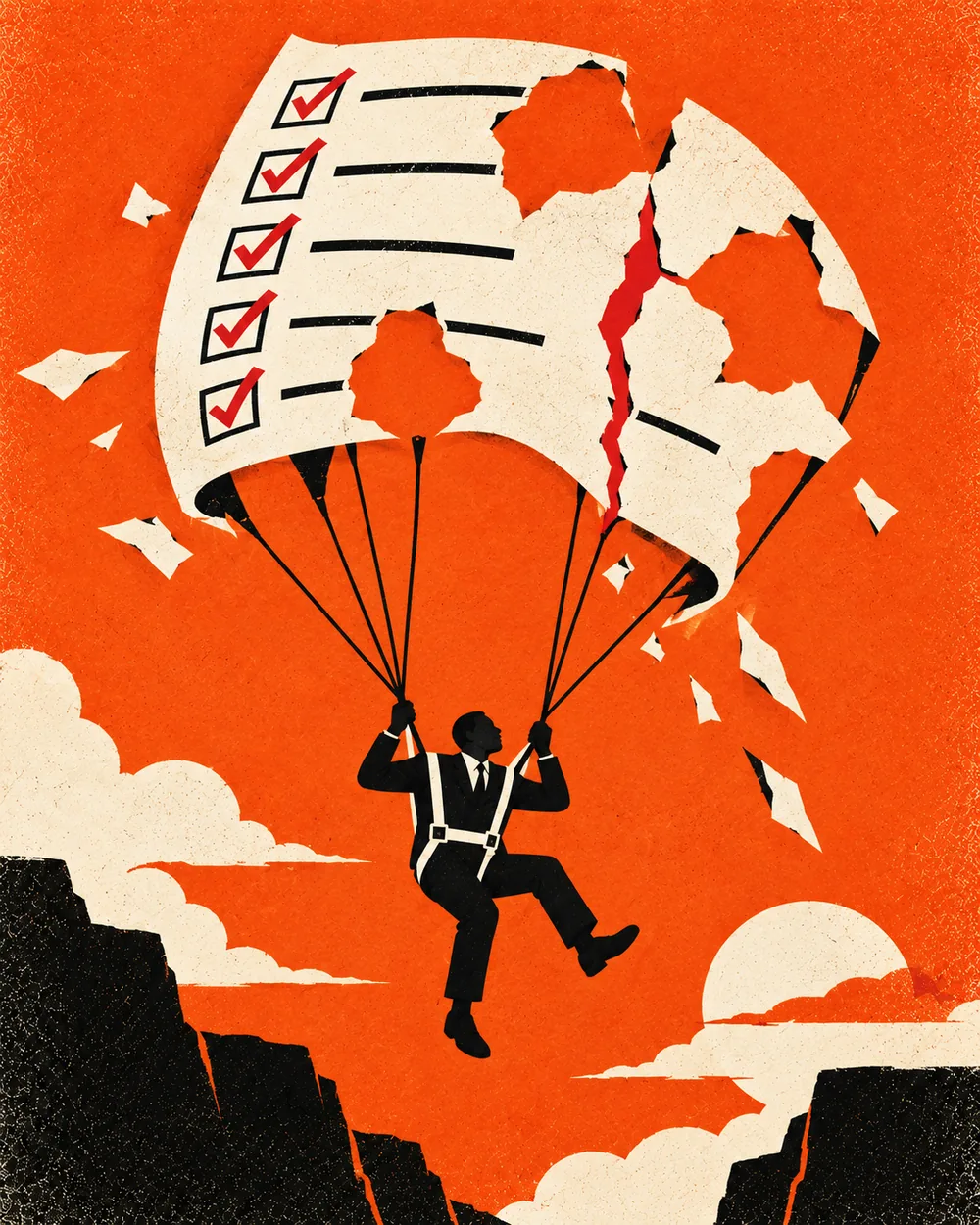
Four days before launch, every row is green. Security review complete. Legal signed. Localization uploaded. Engineering on track. Support trained.
The release dashboard looks like permission to ship. That is exactly why it can be dangerous. A checklist tells you whether the organization completed the process it expected to complete. It does not tell you whether the business can survive what happens when reality disagrees with the checklist.
Green is a comforting abstraction
Enterprise launches do not usually fail because somebody forgot to color a project cell correctly. They fail in edge cases the project plan reduced to a status.
A legacy tenant has an unusual permissions structure. A migration script behaves differently at scale. Support volume jumps because the new workflow is technically correct and operationally confusing. Sales promised parity in an RFP footnote nobody on the product team saw. A customer discovers an audit gap after real data moves through the system.
The launch was green. The failure was real. This is why I think readiness should be defined differently:
Launch readiness is the deliberate exposure of failure under uncertainty.
What breaks first? What does it cost? What will we do about it? Those questions tell me more than whether the meeting occurred.
Process completion and business survivability are different
Checklists are useful. I want security review, legal sign off, support documentation, rollback procedures, and the rest of the operational work required to launch responsibly. The mistake is treating completion of those activities as evidence that uncertainty disappeared. It did not. A product can pass every review and still behave differently in production. The organization can understand every known risk and still be wrong.
Readiness is not the absence of uncertainty. It is evidence that the organization has looked directly at meaningful failure modes and made a deliberate decision about the remaining exposure. That is a higher standard than green.
Put the failure story beside the status story
One practical tool is a short failure mode table. Not a giant risk register nobody opens. A concise artifact for the failures that can materially damage the launch. For each credible failure, capture: Risk: What actually breaks?
Not “permissions are complicated.” Something concrete, such as historical workspaces inheriting the wrong roles after migration. Trigger: What event turns the risk into an incident?
First login? Cutover? Bulk migration? A specific customer configuration?
Impact: What does the business experience? Support load, an SLA breach, revenue exposure, customer lockout, an audit failure, or another meaningful consequence. Mitigation: What do we do before launch, and what do we do if it happens anyway? Narrow scope, a runbook, rollback, monitoring, customer communication, and a named owner. Now the green dashboard has context. Leadership can see both the execution story and the failure story.
Good readiness can make the recommendation narrower
Launch conversations often collapse into go or no go. That is another false binary.
Maybe the answer is go for new customers but hold migration for legacy tenants. Go for a limited cohort. Go with one capability disabled. Delay one week to close a specific failure mode. Launch on time but with an explicit rollback trigger.
The purpose of readiness is not to find enough risk to stop shipping. It is to shape the bet. A good failure model can make the launch smaller, safer, and easier to learn from. That is product judgment.
Risk needs triggers, not adjectives
Risk registers often contain words such as high, medium, and low. Those labels can create the same false comfort as the green launch dashboard. A trigger is more useful. If support tickets cross a defined threshold in the first few hours, what happens? If a legacy tenant fails the permission migration, do we stop the cohort? If error rate crosses the agreed boundary, who has authority to roll back?
Triggers turn risk from a discussion topic into an operating decision. They also reduce the argument during the incident because the organization already agreed what evidence would change the plan. Readiness gets stronger when the team can say not only “we know this might happen,” but “we know what signal will cause us to act.”
Translate the risk into business language
Another readiness failure is describing risk entirely in technical language. “Role inheritance may behave unexpectedly.” That sounds like a bug. What does it mean?
It could mean an enterprise administrator loses access to historical workspaces. Support volume spikes. An audit team cannot access logs during renewal. A large customer cannot complete a critical workflow.
Now the decision has stakes.
This translation matters because the people deciding whether to launch often own different consequences. Security sees incident risk. Support sees ticket load. Sales sees customer commitments. Engineering sees technical scope.
Product has to help the room see one decision.
Readiness is a bet the organization understands
There is no perfect launch. If you wait until every uncertainty disappears, you may never ship. If you use the checklist as evidence that uncertainty disappeared, you are pretending. The more useful standard is that we know the failures that matter most, the triggers we are watching, the likely business impact, the mitigations and owners, and what would cause us to narrow, stop, or roll back. Leadership is consciously accepting the remaining risk.
That is not a guarantee. It is a deliberate bet.
Do not ask executives to cosign hope
A green dashboard can become a comfort object. Everyone gets to say the process was followed. Then when the launch fails, the postmortem discovers concerns people already had but never converted into a decision. I would rather make those concerns visible before traffic flips. Keep the checklist. It is useful.
Then put the failure story beside it. Because “everything is complete” is not the same as “we are ready.” The launch is ready when the organization understands enough of the downside to choose the risk on purpose.