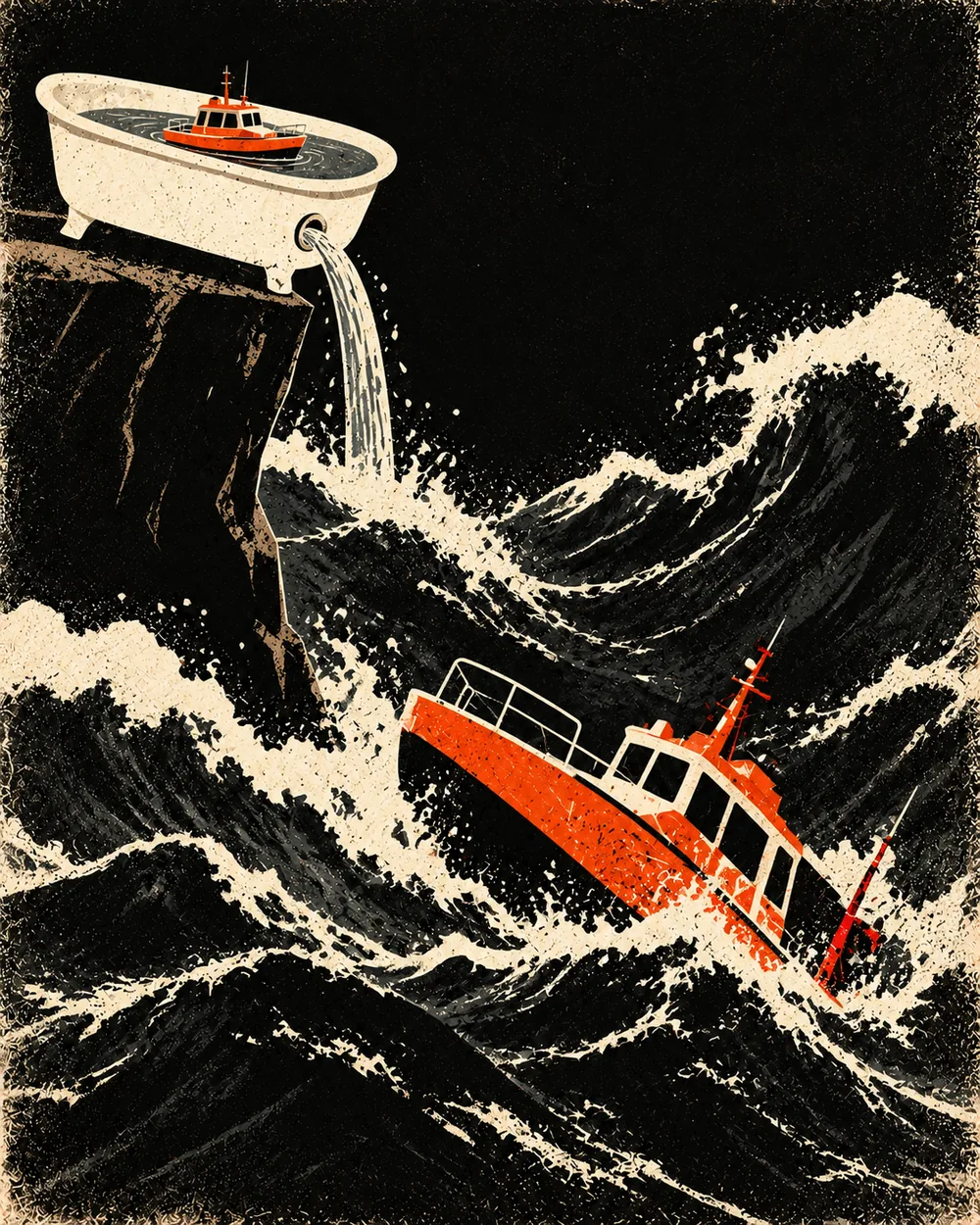
A successful pilot should create excitement.
The team took something uncertain, found a bounded use case, worked through the ugly edge cases, and showed that the capability can create meaningful value. People are using it. The sponsor wants more. Leadership starts asking how quickly the rollout can expand.
That is not the moment to become cynical about the success. It is the moment to change the question. A pilot asks whether the capability can create enough value under experimental conditions to keep learning. Scale asks whether the organization can keep delivering that value once those special conditions start disappearing. The economics are different because the system is different.
Pilots are allowed to borrow support
Good experiments often receive help that no production system should be expected to carry forever.
The Product team knows the participants. Engineers can inspect strange failures directly. A business partner can explain an exception over chat. Users get more onboarding. A manual review step is acceptable because fifty cases are manageable. Reliability can be rougher because everyone understands they are helping test something.
None of that makes the pilot fake. Those conditions are often exactly what allow the team to learn quickly. The scale mistake is forgetting to remove the subsidy from the model.
Which humans were quietly holding the workflow together? Which exceptions were being handled manually? Which costs were absorbed by an experimental budget? Which users were unusually motivated or technically comfortable? Which failures were tolerable only because the cohort knew it was a pilot?
The pilot result includes those conditions. The scale case has to account for what happens when they change.
Then you get the Tuesday bill spike
One version of the transition is almost comical.
The feature launches to a much broader population. Usage is better than expected. The adoption chart goes up and everyone is celebrating. Then Finance or Engineering notices that the cost curve changed much faster than the pilot model suggested.
The company is excited about success and worried about the economics in the same meeting. The bill is only one version of the problem. The same thing can happen with exceptions, human review, support, latency, security work, or business-operations load.
A one-percent exception rate feels tiny with a hundred cases. At a million cases, it can become a permanent human queue. A fallback that was easy for the pilot team to handle becomes a staffing model. A rare failure becomes a daily production event.
The percentage did not necessarily get worse. The denominator changed.
Production has to carry things the pilot could borrow
A production capability needs more than a model and a successful workflow. It may need observability, evaluation, permissions, auditability, fallback behavior, cost controls, security, support tooling, data policies, and clear ownership for what happens when the system behaves badly outside business hours. Those are not random enterprise taxes that appear after Product proves the idea. They are part of making the value dependable enough to operate at scale. The API or model invoice is one part of that cost. So are the people and systems required to make the capability trustworthy, supportable, and recoverable.
The scale case should include the cost of becoming dependable, not only the cost of serving more requests.
The people at scale are different too
Pilot cohorts are often unusually favorable.
They may have volunteered. They may be close to the team. They receive better context and more training. They know rough edges are temporary. The pilot may also run in a cleaner business unit or on data that is easier than the rest of the organization.
Broad rollout introduces people who did not ask for the tool, teams with different incentives, older configurations, messier data, and managers who interpret the workflow differently. Production users do not experience a failure as a charming part of discovery. They experience it as the product being wrong. That changes support, adoption, reliability, and sometimes the value proposition itself. Before extrapolating from the pilot, ask what was unusually favorable about the environment that produced the result.
The scale decision belongs to more than Product
Product should help make the value proposition, segmentation, rollout logic, and experience tradeoffs clear. It should not pretend to answer every scale question alone.
Engineering, ML, or Data partners may understand architecture, reliability, and operating cost. Finance can pressure-test the economics. Business and Operations partners understand staffing, physical workflow, service levels, and what happens when exception volume rises. Security, Risk, Legal, Support, and other functions enter according to the consequence.
The goal is not to collect every function into a giant committee. It is to make the scale decision legible enough that the people carrying the relevant risk and cost can see the same model.
What value are we trying to preserve? Which costs grow with usage? Which pilot conditions disappear? Which risks become meaningful at volume? What must change before broader rollout becomes sustainable?
Scale can change the product
The right answer is not always roll out exactly what we piloted. Scale economics may lead to usage limits, different tiers, model routing, a narrower segment, more automation around exceptions, human review only for high-risk cases, a new support model, or a different price. One workflow may be worth scaling while another is too expensive. One user segment may create far more value from the same cost structure than another. That is not evidence the pilot failed. It is evidence the pilot taught the team enough to design the production product differently.
The product you prove under controlled conditions does not have to be the exact product you take to scale.
A pilot earns the next gate
The useful way to think about pilot success is as permission to ask a harder question.
Did the capability create enough value to justify more learning? Great. Now: can the organization deliver that value reliably without heroic support? Can it absorb the exception volume? Can it afford the actual usage distribution rather than the average? Can business partners support the workflow at the proposed scale? Does the value still justify the full operating cost?
The pilot did not need to answer all of those questions. That was not its job. Scale is a different promise. A successful pilot should make the organization want more. Before giving it more, model what happens if the success is bigger than expected.
The question is not whether the pilot worked. It is whether the economics and operating conditions can survive the fact that it did.