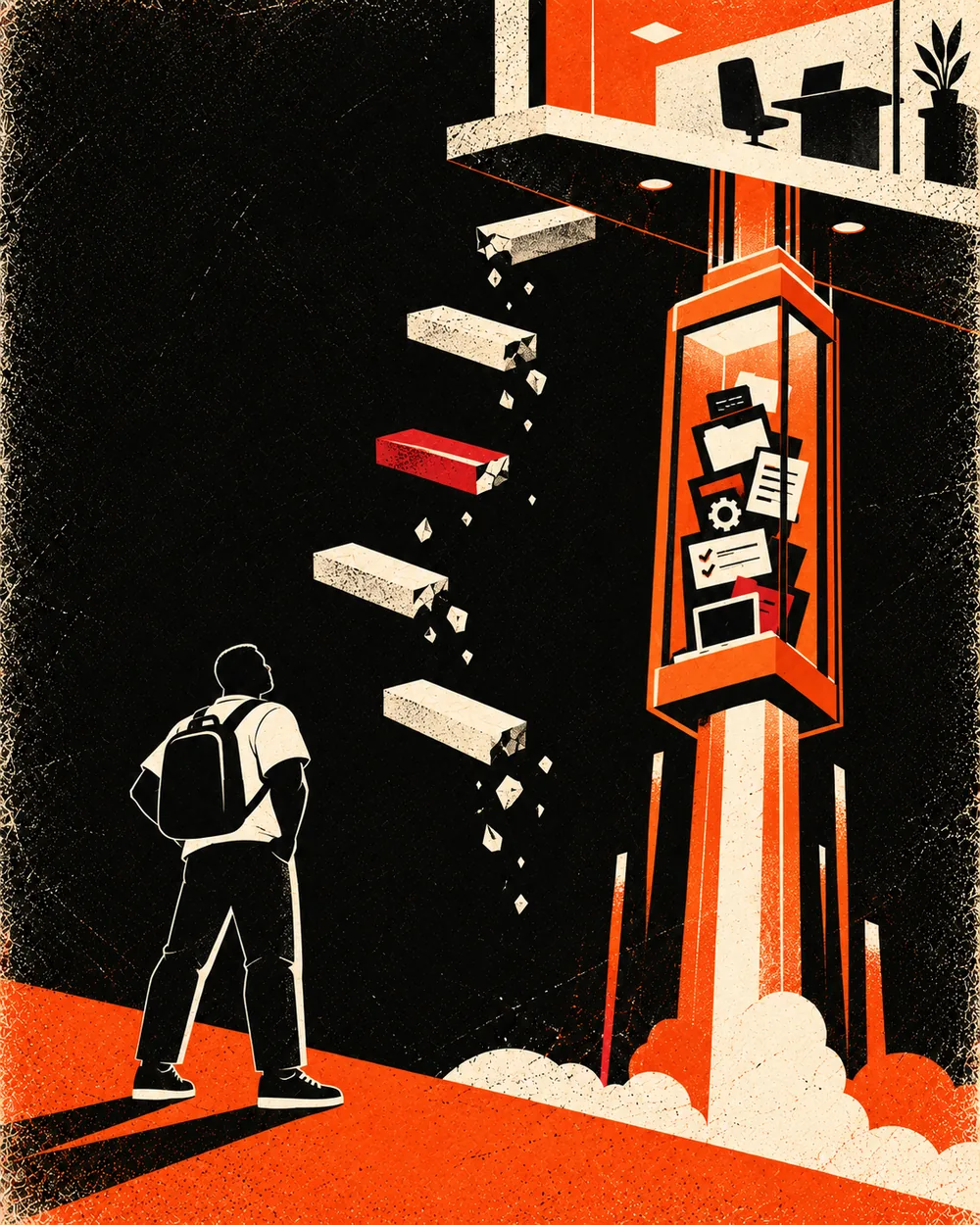
A lot of junior work is bad work. Copying numbers into slides. Cleaning up meeting notes. Reformatting documents. Moving tickets around. Producing the fifth version of an analysis nobody will read. If AI can eliminate that work, good. I do not want to preserve busywork because somebody once suffered through it on the way to becoming experienced. But there is a harder question underneath the productivity gain. What if some of the work we automate was also how people learned to see?
Recent HBR research on early career professionals starts from the same tension: many tasks becoming candidates for AI assisted workflows were also part of the onramp through which people built expertise. That should not make us protect the tasks. It should make us redesign the onramp.
The task and the learning mechanism are not the same thing
Early career work often contains two things at once. There is the visible task. And there is the invisible learning mechanism inside it. A junior PM builds the quarterly review deck. The visible task is slides. But while building it, they have to reconcile numbers, find missing context, ask why a metric moved, discover that two teams define the same measure differently, decide what matters enough to include, and explain the story to someone who was not in the room.
The slides may be low leverage. The exposure is not. If AI creates the deck perfectly, the organization may save hours and accidentally remove the part where the person learned how the business works. That does not mean we should make them build the deck manually forever. It means we should identify what the task was teaching and preserve that mechanism on purpose.
Expertise needs exposure, repetition, correction, and consequence
People do not become senior because enough birthdays pass. They get repeated exposure to situations that force judgment. They make predictions. They see outcomes. They get corrected. They explain why they chose one path over another. They discover which signals matter and which ones only look important. Eventually they build pattern recognition. AI can accelerate many parts of that loop. It can also short circuit it. If the model always gives the first answer, the junior person loses the prediction step.
If the model always drafts the synthesis, they may never struggle with contradictory evidence long enough to understand it. If a senior person silently fixes every AI assisted output, the junior person loses the correction loop. If nobody lets them own a consequential choice, they never learn what it feels like to be responsible for the result.
Do not preserve the chore. Preserve the learning.
This is the design problem for product leaders. Suppose AI can create a strong first pass of a business review. Use it. Then change the learning loop. Ask the junior PM to predict the three most important changes before they read the synthesis. Ask them to inspect the evidence behind one surprising claim. Ask them what the model omitted. Ask them to defend which metric deserves leadership attention. Let them present the recommendation and answer the pushback.
After the quarter, revisit what they got right and wrong. The old task was slide production. The learning mechanism was business interpretation, prioritization, explanation, and feedback. Keep the second part. Delete as much of the first as technology allows.
Staged ownership matters
One development pattern I keep coming back to is staged ownership. First the experienced person carries the work while making the judgment visible. Then the learner participates in the decision. Then they own the call with support nearby. Eventually the senior person can step away and the learner can help somebody else.
Capability is not transferred by watching a senior person be impressive. It transfers when responsibility moves.
AI should fit inside that progression, not replace it. A model can provide examples, critique a draft, surface missing evidence, simulate objections, or accelerate the mechanics. The developing person still needs turns where their judgment carries real weight.
Senior judgment cannot become a protected class
There is a tempting operating model where AI does the junior work and senior people review everything. It can look efficient for a while. The most experienced people become the approval layer. Everyone else becomes an operator of generation tools. The problem is obvious if you extend the timeline. Where do the next senior reviewers come from? If the organization concentrates consequential judgment in the people who already have it, it may improve short term output while weakening its future capability.
That is not an argument against AI. It is an argument for treating expertise development as part of the operating model.
Give people real decisions to carry
Not catastrophic decisions. Consequential ones. Let a developing PM own the customer readout where a decision has to be made. Let them recommend the scope tradeoff. Let them run the experiment review. Let them make the first call, explain the evidence, and experience correction. Use AI to make the preparation faster. Use senior people to coach the judgment. Then increase autonomy as the person demonstrates that they can carry more consequence.
This is more work than saying, “AI handles the junior stuff now.” It is also how you avoid hollowing out the talent system.
Automate labor. Design apprenticeship.
Every generation of tools removes work that used to teach people something. That is not automatically a loss. Some work deserved to disappear. The leadership mistake is failing to notice when the learning disappeared with it. So when AI takes over a recurring junior task, ask two questions. What labor did we remove? And what learning did that labor accidentally contain? If the learning mattered, rebuild it in a better form.
Prediction before assistance. Evidence inspection instead of blind acceptance. Critique instead of transcription. Small decisions with real consequence. Outcome reviews that connect choices to results. Progressive autonomy instead of permanent review queues. The goal is not to make junior people work the way senior people once did. The goal is to make sure the organization still knows how to create senior people at all.