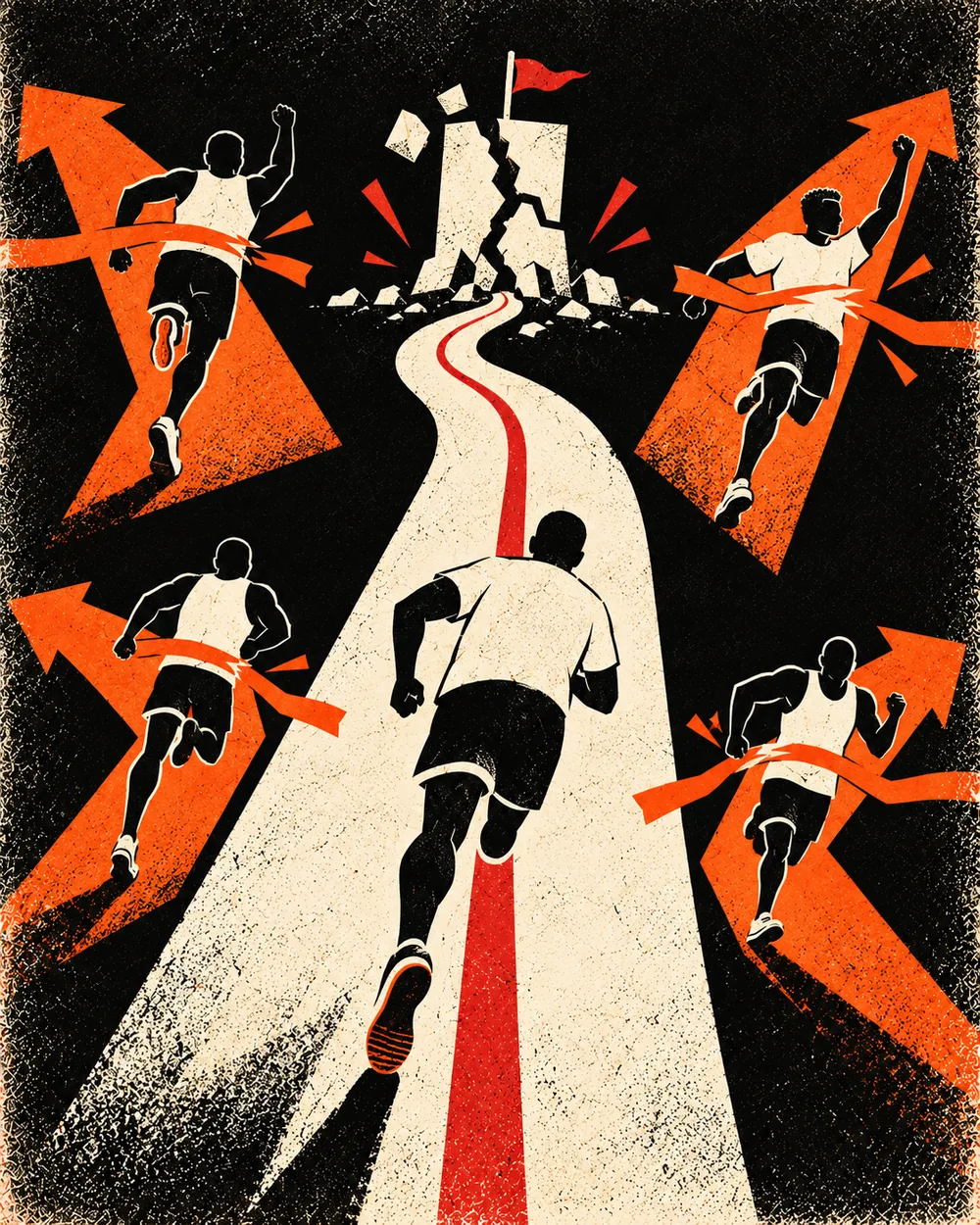
There is a particular kind of product failure that is hard to argue with because everybody has evidence that they are doing a good job. Team A hit its adoption target. Team B improved task completion. Team C reduced latency. Team D shipped the roadmap it committed to. Every dashboard is green. The customer experience is getting worse. Nobody is lying. That is what makes the problem interesting. Rational teams can create an irrational product system when the outcome crosses boundaries that the accountability does not.
The organization decomposes the work
We have to split large systems into teams. That is not the mistake. Teams need bounded ownership. Domain expertise matters. Local decisions should usually stay local. If every product decision required a global council because “everything affects everything,” the organization would stop moving. The problem starts when the organization assumes the customer experiences those same boundaries. They do not. Customers experience the sum. Employees using internal products experience the sum too.
They move from one application to another, one workflow to another, one policy to another, one team’s decision to another team’s dependency. The seams become part of the product even when no team owns the seam.
Local success can create system cost
I saw this clearly in store systems. Individual applications were often improving for legitimate reasons. Teams had specific problems to solve. They had roadmaps, users, metrics, engineering constraints, and business partners. Locally, the work made sense. Across the associate experience, something else was happening. More surfaces. Different navigation patterns. Different interaction models. Repeated capabilities. More context switching. More ways for the person in the store to experience the company as a collection of product teams instead of one operating environment.
That was part of the motivation behind an effort to create a more common associate experience across store applications: shared navigation, shared patterns, and fewer locally invented ways to solve the same interaction problem. The point was not that every application team had failed. The point was almost the opposite. A system can fragment through a long series of reasonable local decisions.
The metrics usually stop too early
This happens because accountability is usually designed around the team boundary. The team owns the metric it can influence. The team owns the roadmap it can fund. The team owns the system it can change. Again, reasonable. But a customer outcome may depend on five of those teams being good together. One team reduces its handling time by handing more work downstream. Another improves conversion by creating support complexity. A platform protects reliability by making a dependent team wait months for a change.
An application optimizes its own navigation while increasing the total cognitive burden across the ecosystem. Every local decision can be defensible. The externality lives somewhere else. If nobody can see the whole path, the organization will keep rewarding the pieces.
Horizontal visibility is not the same as central control
The answer is not to create one giant owner for everything. It is to make the cross boundary outcome visible enough that local decisions can be evaluated in context. We used journey based views for exactly this reason. Vertical teams could keep their roadmaps and accountable owners, while a horizontal view connected the experience across systems and stages so the organization could ask questions that no single product view could answer cleanly.
Where does the experience break between products? Which metric gets worse downstream when another metric improves upstream? Which dependencies keep appearing across otherwise unrelated roadmaps? What problem is everybody partially seeing but nobody is positioned to own? That is not a request to centralize the work. It is a request to stop making the seams invisible.
Visibility still does not decide the tradeoff
Systems thinking can get romantic here too. You can make the whole visible and still not have an answer. I saw that in work to create a more unified way of assigning and prioritizing store tasks. A common task model and shared priority language can help several systems coordinate work. Technology can make the conflict legible, create a common vocabulary, and make dependencies easier to see. But if two legitimate business priorities compete for the same associate, the platform cannot invent the organizational decision right.
Which task wins? Who has authority to make that call? What business consequence should dominate? What happens when two functions both have valid reasons to say their work is urgent? At some point the product system reaches a governance boundary. The software can expose the tradeoff. The organization still has to own it.
Do not turn horizontal thinking into another tax
There is a predictable failure mode here. Leadership sees cross team problems and responds with more coordination. More councils. More dependency meetings. More reviews. More portfolio slides. Now every team is slower and the system is still fragmented. Not every dependency deserves horizontal governance. Not every local optimization creates a meaningful externality. The horizontal layer should exist where the outcome is genuinely shared and the cost of uncoordinated decisions is material.
Otherwise autonomy should win. The purpose is not more synchronization. The purpose is to see the tradeoffs that the org chart hides.
Measure the whole without pretending you own the whole
This is the standard I like. Pick one important outcome. Map the teams and systems it crosses. Ask what each team is measured on. Ask where one team’s success creates cost for another. Ask which seam is repeatedly failing. Then ask the uncomfortable question:
Which real tradeoff has no owner?
That is often where the product is losing between the green dashboards. Empowered teams are good. Local ownership is good. Clear accountability is good. But if accountability stops at the team boundary while the outcome keeps going, somebody has to make the whole visible. Otherwise every team can win. And the product can still lose.