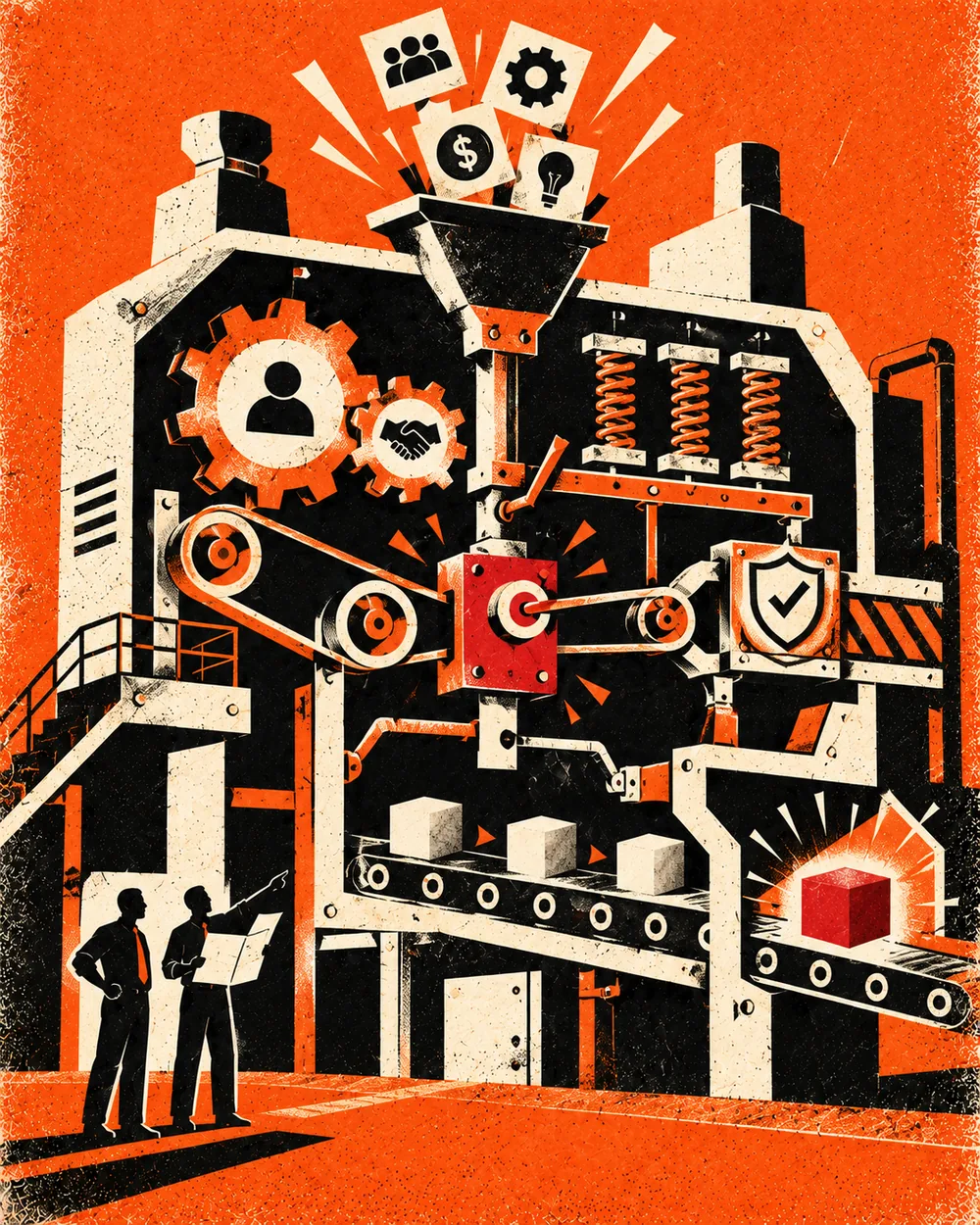
A technology capability can be ready before the organization around it is ready to create value from it. Imagine an enterprise operations team pilots an AI capability that can detect a fulfillment disruption and recommend a better response. It can identify that inventory should be rerouted, suggest which facility should absorb the work, and surface the likely tradeoff between cost, speed, and availability. In the pilot, the recommendations are useful enough that leadership wants to scale. Then the harder questions arrive.
Who is allowed to reroute the inventory? Within what thresholds? What happens when the cheapest answer creates a customer-service problem somewhere else? Who owns the exception? Which team is accountable after the recommendation leaves the system? What metric wins when cost, speed, labor, and availability point in different directions?
The software may be working. The value-delivery system around it is still unresolved. That is the point where the Product problem gets bigger.
A rollout is not automatically a transformation
I would reserve the word transformation for a material change in how the organization creates value and gets work done.
Installing a tool is a rollout. People using it is adoption. Training people on it is part of change management. Those things can all be necessary, but they do not by themselves mean the organization changed how work moves, who decides, or how value gets produced.
In the fulfillment example, the organization could put the AI recommendation on a dashboard and preserve every existing approval, handoff, exception path, and ownership boundary. An analyst gets the answer faster. A manager reviews it faster. The same customer outcome may still take just as long because the recommendation waits inside the same operating system.
That is useful local productivity. It is not yet a different value-delivery model.
The capability reveals the operating model around it
An operating model can sound like abstract consulting language until a new capability collides with one. Then it becomes very concrete.
The work has a sequence. People and teams own different parts of it. Decisions sit at particular levels. Guardrails constrain what can happen without approval. Exceptions travel somewhere. Metrics encourage certain behaviors. Technology and data connect—or fail to connect—the pieces. Governance determines what happens when the normal path breaks.
All of that existed before the new capability. The capability simply made the seams harder to ignore. If AI can recommend a reroute in seconds but a person still has to email three groups for approval, the constraint moved. If the recommendation optimizes transportation cost while the store team is measured on availability, the system has conflicting goals. If nobody knows who owns a bad recommendation after it triggers downstream work, the accountability problem is part of the design whether or not it appears in the interface.
The operating model is not background context anymore. It is determining whether the Product promise can exist.
Task-level productivity can improve while the outcome stays the same
This is one reason technology programs can look productive without changing the business very much.
A report takes ten minutes instead of an hour. An exception is classified automatically. A recommendation appears instantly. A manager gets a better summary. Those are real gains and should not be dismissed.
But zoom out far enough and ask what happened to the thing the customer or business actually cares about.
Did the order recover faster? Did inventory become available sooner? Did fewer cases require escalation? Did the organization remove a handoff, move a decision, or change the way exceptions are handled? Did the capacity created by the tool become more throughput, better quality, lower cost, or something else the business values?
If not, the organization may have improved tasks while leaving the system largely intact. The next Product question is not what else can the model do? It is what should the work look like now that this capability exists?
Product craft still applies when the object of design gets larger
Product people already know how to investigate systems they do not fully understand.
We observe the real workflow instead of trusting the process diagram. We look for where people wait and where they route around the product. We separate the stated problem from the requested solution. We make tradeoffs visible. We prototype a smaller change. We define what good looks like, instrument the outcome, learn from failure, and iterate.
Those same disciplines can be applied to the value-delivery system around a technology capability.
In the fulfillment example, the team might test a narrower future state before redesigning the whole operation. Give the system authority to recommend only within a bounded cost threshold. Let a specific operations role approve exceptions. Instrument which recommendations are accepted, rejected, overridden, and why. Compare whether the new flow actually recovers orders faster without creating unacceptable downstream cost or risk.
The artifact may be a workflow, a service blueprint, a decision map, a prototype of a new approval path, or a small operational pilot. The Product discipline is still recognizable even though the object being designed is larger than the software.
Product does not own every lever
This argument gets silly if it turns into Product should own the organization.
The decision rights may belong to Operations. Risk may own a guardrail. Finance may need to define an economic threshold. HR may be involved if roles materially change. Engineering and Data own important parts of how the capability operates. Business leadership may be the only group with authority to change incentives, staffing, or accountability across organizations.
Product leadership still has a role: recognize when those conditions have entered the Product problem, make the system visible, and help the organization reason about the tradeoffs as one value-delivery problem rather than a collection of local tickets. That is different from claiming authority you do not have.
A PM may first notice that a feature cannot create the promised outcome because the surrounding workflow is broken. A principal may map the seams across several teams. A director may be able to change ownership, operating mechanisms, or portfolio boundaries. At broader leadership altitude, the work increasingly becomes designing the conditions under which multiple teams can create value together.
The authority changes with altitude. The systems thinking should not.
Sometimes the software is only one component of the product problem
The reason I like thinking this way is that it protects teams from a very common transformation failure: declaring victory because the technology is ready while the organization that has to use it still operates exactly as before.
If the new capability materially changes what is possible, the surrounding system may need to change with it. The workflow may need fewer steps. A decision may move. An exception may get a new owner. A control may become an automated guardrail instead of a meeting. A metric may need to change because the old one rewards the old behavior.
That does not happen for every feature, and it should not become an excuse to make every Product initiative an organizational redesign program. But in major transformation work, the boundary can legitimately expand. The thing being designed is not only the interface or the model. It is the combination of technology, work, ownership, decisions, guardrails, and feedback that allows the promised outcome to happen repeatedly. Sometimes the software is the product.
Sometimes the software is one component of the product you are actually responsible for changing.