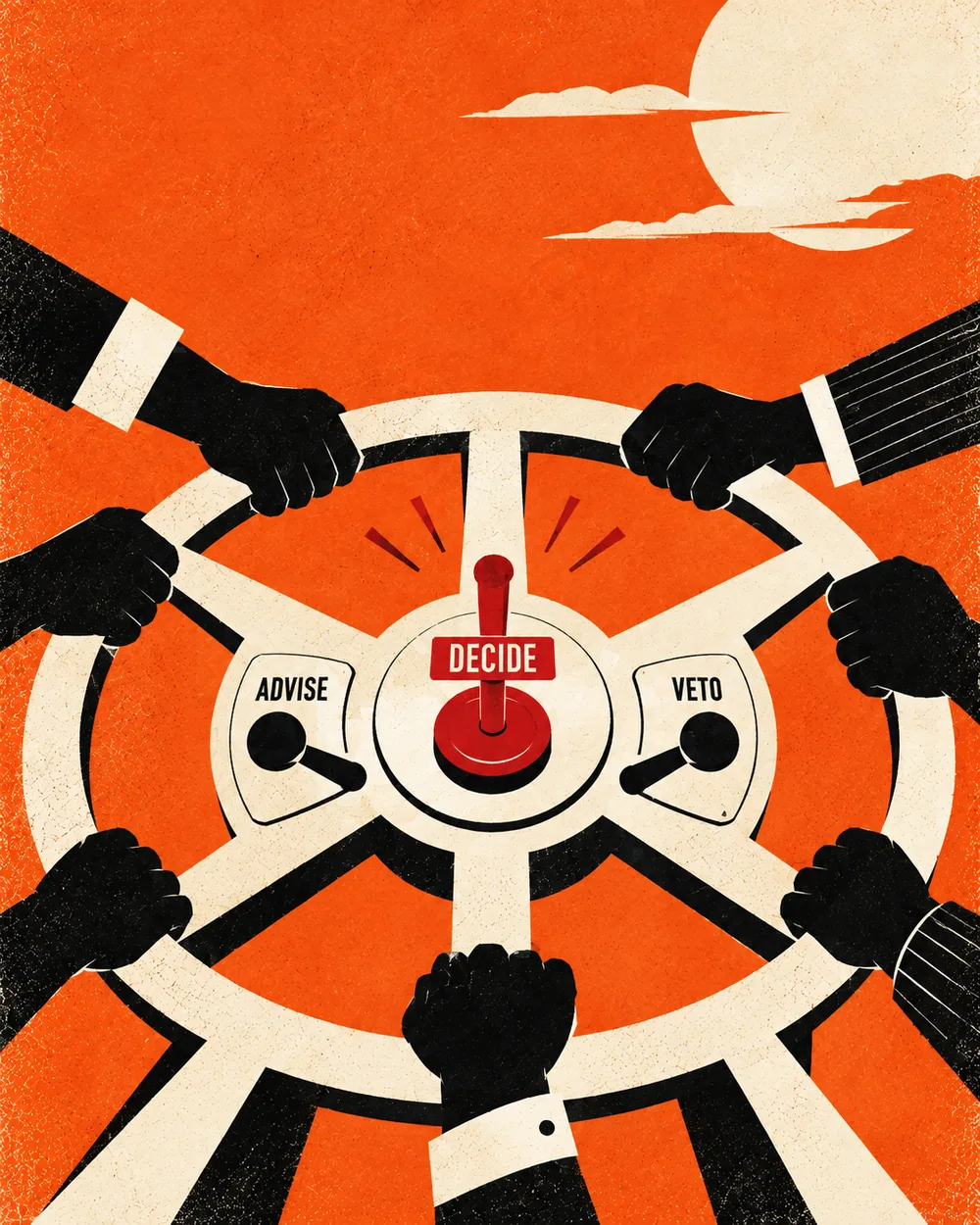
A team can have excellent collaboration habits and still be unable to make a decision.
Everyone is invited. Everyone is heard. Design has strong opinions. Product has strong opinions. Engineering has legitimate constraints. Sales brings customer context. Leadership wants alignment.
Six weeks later, the onboarding flow is still stuck. This is not always a collaboration problem. Sometimes it is a decision rights problem.
Participation is not authority
There is a difference between having input into a decision and owning the decision. Product organizations blur that difference constantly. We tell teams to collaborate. Good. Then we leave every recurring decision politically undefined.
Who owns the roadmap choice? Who owns the experience standard? Who decides when customer data requirements conflict with usability? Who can veto? Who is consulted? Who breaks a tie?
Nobody knows until disagreement appears. Then the organization discovers its real governance model, which is often whoever argues longest, whoever has the highest title, or whoever can escalate fastest. That is not empowerment. It is shadow politics.
Consensus is not the same as collaboration
Consensus feels fair. If everyone agrees, nobody loses.
The problem is that important product work puts legitimate perspectives in tension. Design may prioritize long term trust and usability. Product may need data that supports the business model. Engineering may know one approach creates unacceptable technical risk. Legal may have a constraint nobody can negotiate away.
You do not solve those tensions by requiring everyone to feel equally happy. Sometimes somebody has to decide. A collaborative system gives people meaningful input before that decision. A consensus system quietly gives everyone veto power. Those are different operating models.
One accountable owner is clearer than two co owners
Organizations create co ownership because it sounds collaborative. “Product and Design jointly own onboarding.” What happens when Product and Design disagree? If the answer is “they work it out,” you have not defined ownership. You have postponed the governance question until the conflict is expensive.
For a recurring decision, I want one accountable owner. That does not mean the owner makes decisions alone. It means everyone knows where the final call sits after the required expertise has been included.
Design can own interaction quality. Product can own a commercial tradeoff. Engineering can own technical safety boundaries. The specific mapping will vary.
The important part is that the mapping exists before the crisis.
Consulted does not mean veto
This is another word organizations use loosely. “We need to consult Security.”
Does Security have to approve? Are they providing risk information? Do they own a nonnegotiable policy? What happens if Product disagrees?
If those answers are unclear, “consulted” can turn into hidden veto power. That creates slow, frustrating organizations because people cannot tell whether they are gathering input or negotiating permission. Be explicit. Some functions should have hard boundaries. Security may genuinely own a standard the product cannot override. Legal may own regulatory interpretation.
That is fine. Name it.
Governance can reduce bureaucracy
People hear decision rights and imagine matrices, charts, and corporate process. Bad governance can absolutely become bureaucracy. But the absence of explicit governance does not create freedom. It often creates more meetings, more escalation, more back channel negotiation, more rework, and more executive intervention in tiny decisions. That is bureaucracy too. It is simply informal bureaucracy.
I would rather have a one page decision map than six weeks of alignment.
Decision rights belong to decisions, not titles
One reason governance gets confused is that organizations try to answer the question at the job level. “Product owns the product.” “Design owns the experience.” “Engineering owns technology.” Those statements are too broad to resolve the conflicts that matter.
A single initiative can contain several different decisions. Which customer problem do we pursue? Which interaction pattern meets the experience standard? Which architecture is safe enough to operate? Which data is required for the business model? Which rollout risk is acceptable?
Different decisions can legitimately have different accountable owners. The useful unit of governance is the recurring decision, not a territorial claim over the whole product.
Map the recurring decisions, not every decision
You do not need a governance model for button color. Start with the decisions that repeatedly generate conflict or escalation. For an onboarding product, maybe that means experience standards, data capture requirements, rollout scope, instrumentation, and launch readiness. For each one, ask who owns the final call, who must contribute, who needs to be informed, and what conditions trigger escalation. Now the system has a default. The team can still adapt, but it does not rediscover authority every time smart people disagree.
The goal is decision velocity with expertise intact
Clear ownership is not a license for the accountable person to ignore everyone else. That is just dictatorship with a matrix. The best decision systems combine deep cross functional input with a clear way to finish the decision. You want the designer's expertise, the engineer's feasibility judgment, the analyst's evidence, the salesperson's market context, and the Support team's operational reality. Then somebody has to integrate the tradeoff and choose.
That is collaboration.
If everything escalates, the system is telling you something
A CPO should not be arbitrating every onboarding detail. If senior executives repeatedly get pulled into the same class of decision, the organization is missing a rule, an owner, or a shared principle. Do not celebrate the executive for being decisive. Fix the system that made the escalation necessary. The next time a cross functional team is stuck, resist the urge to schedule another alignment meeting.
Ask the more uncomfortable question:
Who actually gets to decide?
Then make the answer visible before the next disagreement. Collaboration works better when everyone knows how the collaboration becomes a decision.