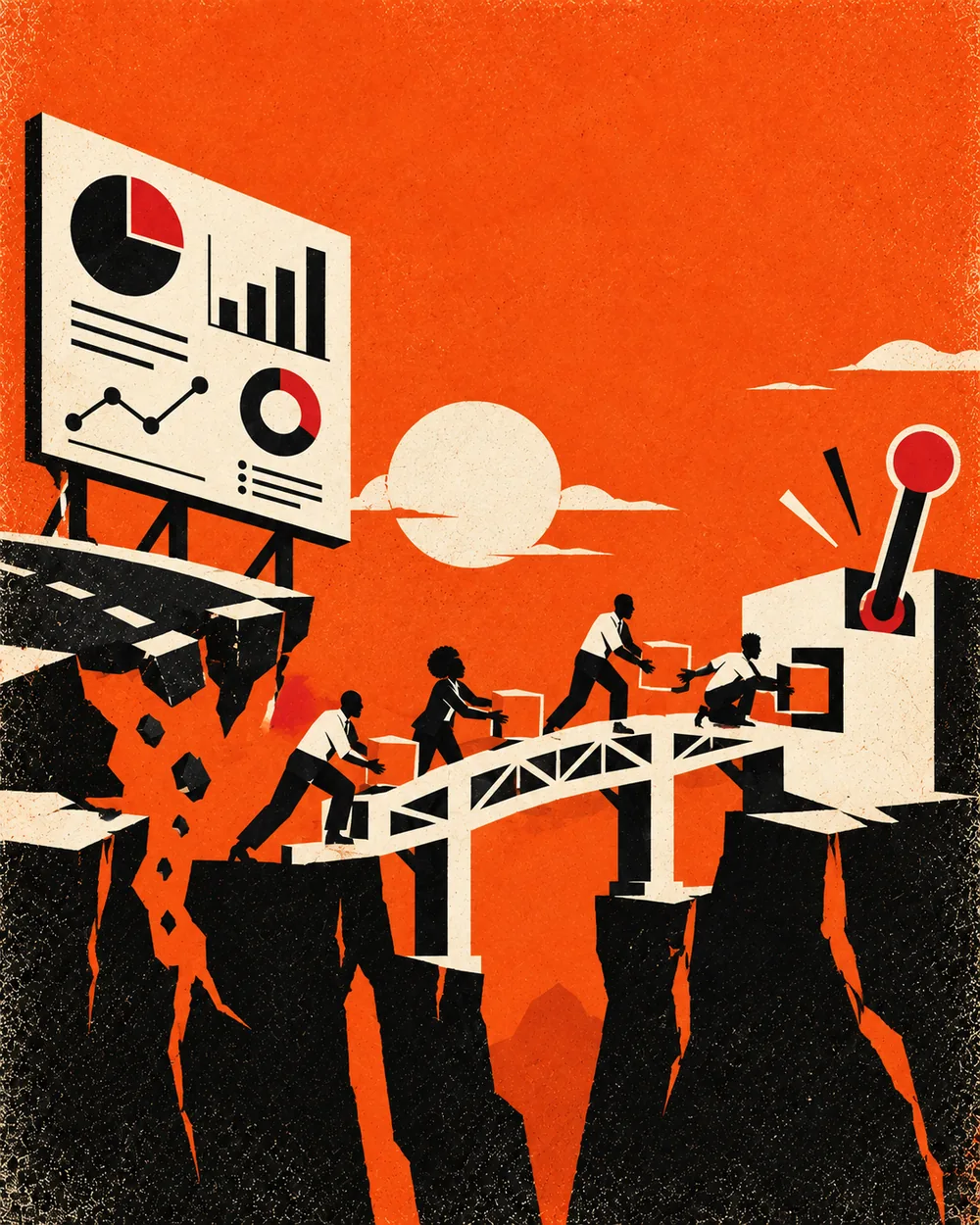
Imagine a product organization spread across regions and product lines. One team runs its roadmap through Notion. Another has an Excel workbook with enough tabs to qualify as organizational folklore. A third bought a separate tool because it fit how that team wanted to work.
Leadership has dashboards everywhere. The organization is still spending an absurd amount of time in sync meetings. That combination should tell you something. More visibility does not automatically create more clarity. More reporting does not automatically create faster decisions. Sometimes all you have done is build a higher resolution picture of gridlock.
Product Ops gets misunderstood when the function becomes more focused on reporting about the organization than helping the organization operate. It should not exist primarily to produce reports about the Product organization. It should help the Product organization operate.
The tools and process are not the point
Most descriptions of Product Ops include some version of the same ingredients: tooling, process, data, feedback, operating cadence, and cross functional alignment. Fine. Those are real responsibilities. But they are inputs. The more important question is what those inputs make possible.
Did the organization get better at turning evidence into a decision? Did the right person receive the signal? Did they know they owned the call? Did the decision happen in time to matter? Did everyone downstream know what changed?
If not, the tool stack may be cleaner while the operating system is still broken.
A dashboard is not a decision
Analytics can tell you what happened. A dashboard can tell you retention dropped, adoption moved, a region missed its target, or a queue is growing. Useful information.
But the dashboard cannot answer the questions that determine whether the organization moves: Who owns the decision? When does it get made? What evidence is required? What happens immediately afterward?
If those answers are unclear, the organization gets insight without commitment. Everyone can see the problem. Nobody owns what happens next. The natural response is a meeting. Then another meeting. Then a recurring status meeting to prepare for the meeting where a decision might eventually happen.
Human synchronization becomes the glue holding together an operating model that never got designed. That is expensive, and it does not scale.
Product Ops should connect evidence to action
I like thinking about Product Ops as a nervous system for the product organization. Not the brain. That distinction matters because Product Ops should not make every product decision. It should not turn PMs into people waiting for approval from a central process team, and it should not flatten legitimate differences between regions, products, or customer segments. A nervous system does something else. It helps signals move, creates enough shared language to interpret them, and gives the larger system a way to respond.
A useful Product Ops system usually has to solve three connected problems:
Evidence. Flow. Forums.
The implementation can vary by organization. The point is that the signal, the path it travels, and the place where a decision gets made have to work together.
Evidence
Teams need enough shared language to understand the same signal. If “active user” means one thing in North America and something materially different somewhere else, a leadership dashboard is not creating alignment. It is combining incompatible definitions under one label. Product Ops can help create the structure that makes evidence usable: shared definitions where shared definitions make sense, known owners, and explicit exceptions where local reality genuinely differs. The goal is not metric bureaucracy.
The goal is making sure the organization is not making different decisions because two teams meant different things by the same word.
Flow
Organizations also need a visible path for demand and evidence.
Analytics requests arrive in Slack. Research requests appear in side conversations. Sales asks a PM directly. An executive drops something into chat. Every request seems urgent because the system has no way to compare them.
A shared intake path does not solve prioritization by itself. It makes the work visible enough to prioritize. That distinction matters. Product Ops can reduce the amount of invisible demand that lives in favors, private messages, and whoever happens to know the right person. The goal is not to centralize every decision. It is to create a common doorway.
Forums
Then comes the part many organizations avoid: the place where someone actually decides. A good decision forum is not a status meeting with a more sophisticated name. It has an explicit decision to make, evidence prepared in advance, people in the room because they have a role in that decision, and a documented outcome afterward. If the purpose of the meeting is “alignment,” I would ask: Alignment around what decision?
If nobody knows, there is a decent chance the meeting exists because the operating model is compensating for missing infrastructure.
Standardize the interfaces, not the judgment
Product Ops can go wrong in the opposite direction too. A leader sees fragmentation and decides the answer is one tool, one template, one process, one exact method for every team. That can be just as bad as the chaos. A platform team may need a different cadence than a growth team. A regulated market may have constraints another market does not. A mature product should not necessarily operate exactly like an experimental one.
Local differences are real. But local differences do not automatically require a completely bespoke decision system. The data you can collect may differ. The basic questions can still be shared:
What evidence supports the decision? Who owns the call? Where does the request enter the system? What happens afterward? How is the result recorded?
That is the balance I want from Product Ops:
Standardize the interfaces around decision making without centralizing the judgment itself.
Give teams autonomy inside a system the organization can understand.
Stop measuring Product Ops by how much process it creates
This is the trap. A Product Ops function launches templates, adds dashboards, documents ceremonies, rolls out a tool, and creates a monthly reporting packet. The work is visible.
But is the organization making better decisions? Are PMs spending less time chasing information? Are executives getting fewer contradictory answers? Are unnecessary status meetings disappearing? Can a decision travel from evidence to owner to action with less friction?
If not, the operation may have improved its reporting without improving its operating. Product Ops should create leverage, not administrative mass.
The test is whether something moves
There is a simple test I keep coming back to:
If the dashboard changed but nobody's decision changed, Product Ops has not done enough.
Sometimes the correct decision is to do nothing. That is still a decision. What matters is that evidence enters a system where ownership is clear, tradeoffs can be made, action can follow, and the organization can learn from what happened next. That is what scales. A product organization needs a way to sense, route, decide, and learn.
Build that, and Product Ops becomes infrastructure. Fail to build it, and you may still have excellent reporting. You will just have excellent reporting about why everything is stuck.