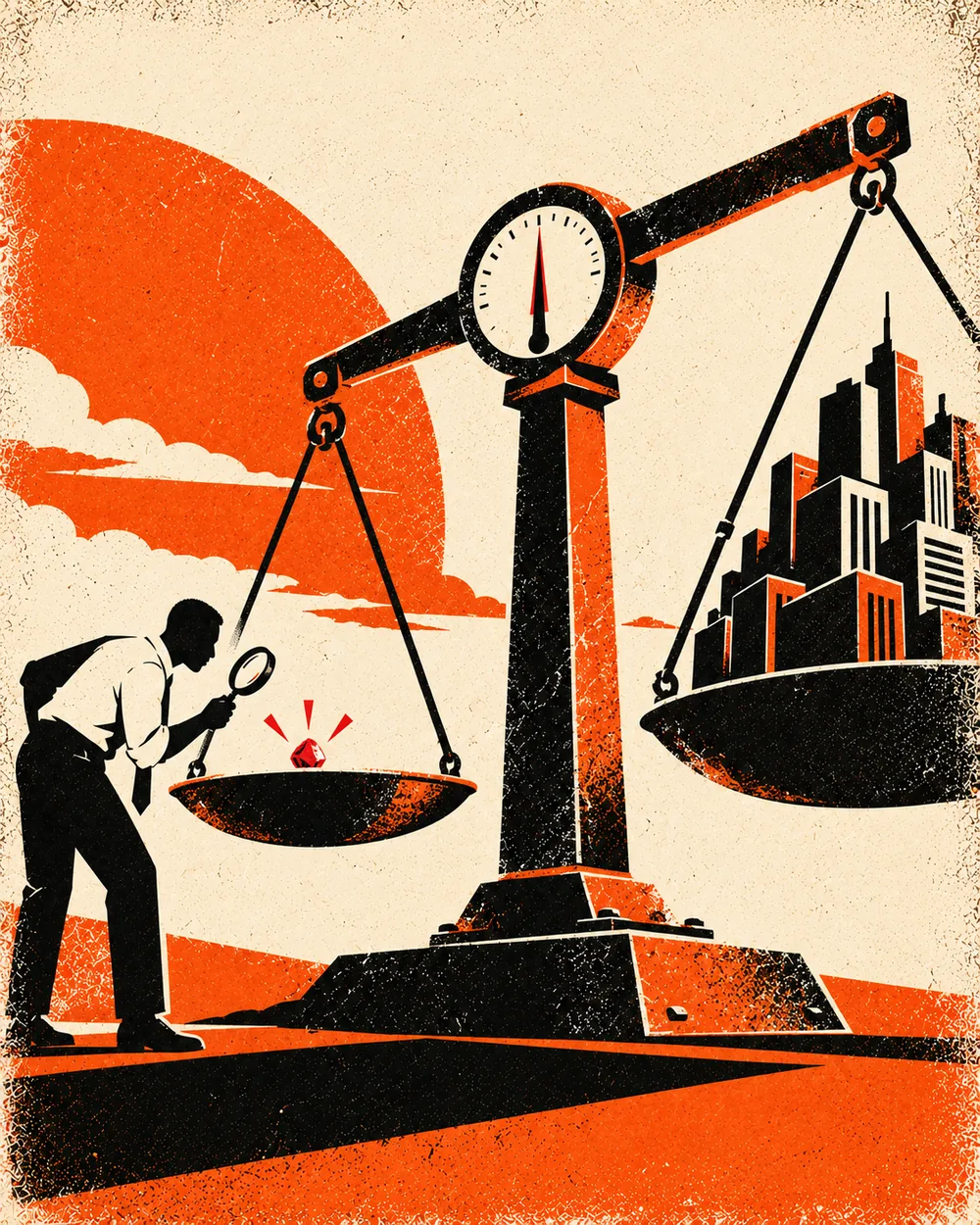
One of the more frustrating Product lessons is that you can find a real problem, understand it well, and still lose the investment decision.
The pain can be legitimate. The evidence can be strong. The customer can be right. The team can have a credible way to improve the experience.
And the business can still say no. That does not automatically mean leadership is ignoring customers or that Product failed to tell the story well enough. Sometimes the opportunity is colliding with the denominator of the company evaluating it.
The same opportunity changes size depending on who is looking
Imagine a credible $10 million annual opportunity. For a startup doing $1 million in revenue, that can define the company. For a $100 million business, it can materially affect the plan. For a company doing tens of billions, the same opportunity may struggle to compete with other uses of capital, engineering capacity, operating attention, and leadership time. The opportunity did not get smaller. The company got larger around it.
That difference changes what “meaningful” means. A business that needs billions in new growth to move its commitments cannot evaluate every opportunity the way a startup looking for its first durable wedge would. Neither side has to be irrational for the same market to look completely different.
Real pain and a weak investment case can coexist
I have had versions of this conversation with people who were doing exactly what we wanted Product people to do. They were in the field, talking to associates, seeing friction firsthand, collecting evidence, and finding something that was clearly painful. Then the economics got pressure-tested and the opportunity landed in the neighborhood of a million dollars annually. In ordinary life, that is a lot of money. Inside a giant enterprise, it may not be enough to justify a major funded initiative by itself—especially when the value is mostly efficiency and the business still has to explain how that released time turns into an actual financial or operating benefit.
That can feel brutal because the Product work was not wrong. The pain was real. The discovery was useful. The investment threshold was simply much larger than the person expected.
Those statements can all be true at once.
“The business does not care” is the wrong lesson
Product leadership matters here because people need help separating customer truth from portfolio reality.
A person who has spent weeks understanding a problem can hear “too small” as “we do not care.” That interpretation is understandable, but it teaches the wrong thing. The company is not only comparing this opportunity with doing nothing. It is comparing it with every other claim on scarce capacity.
What revenue could another bet create? What cost could another initiative remove? What risk does another investment reduce? How much operational change does this one require? How many teams have to move? How much management attention will it consume? Is there a path to scale the benefit beyond the first problem we found?
The business can care about the customer pain and still decide that another use of the same resources matters more right now. That is not the same as saying the problem is unimportant.
“Too small” is not only about revenue
The denominator can also come from the operating model. A large enterprise software company built around seven-figure contracts may find a $20,000-a-year product hard to serve profitably with the same sales and support structure. A retailer may find an efficiency opportunity attractive in theory but difficult to capture financially if it does not change labor hours, throughput, availability, or another measurable operating result. A business can see demand and still have the wrong channel, implementation model, cost base, support expectations, or procurement process for the opportunity. So the question is not simply:
Is this a real market or problem?
It is also:
Can this organization serve it in a way that matters?
That second question is where otherwise-good ideas often lose.
A no today does not have to erase the evidence
“Not large enough for a major funded initiative” is still different from “never touch this again.”
Sometimes a smaller improvement fits inside adjacent work. A balanced team may have a narrow way to reduce the pain without pretending the company has approved a new strategic program. An experiment may help establish whether the opportunity is larger than the first estimate. Another initiative may create a platform or capability that changes the economics later.
The important thing is not to turn that into shadow prioritization where every team quietly pursues whatever it likes. It is to preserve the evidence and the conditions under which the decision might change.
What would have to become true for this problem to clear the threshold? More affected customers? A lower cost to serve? A reusable capability? A stronger link to revenue, margin, throughput, or risk? A different channel?
“No” becomes more useful when it includes the denominator behind it.
Why startups can love opportunities incumbents ignore
A small market can be a perfectly rational place for a startup to begin. The company does not need the opportunity to move a giant installed base. It needs a wedge large enough to survive, learn, and grow from. It can also build the business around that wedge from the beginning: different pricing, support, sales motion, cost structure, and definition of what counts as meaningful growth.
The incumbent may not be foolish for passing. The startup may not be foolish for committing everything to it. They are solving against different denominators. That is also why large companies need to be careful. If every future opportunity has to clear the economics of the mature core on day one, the organization can filter out exactly the small spaces where future businesses begin. “Too small for us today” should not quietly become “not real.”
One is an investment decision. The other is a claim about the market.
Put the denominator next to the opportunity
Product teams spend a lot of time estimating opportunity size. I want the next question beside it: how large does this opportunity have to become before this organization materially cares?
That forces the full decision into view. How big is the prize? What does it cost to pursue? What does the company have to stop or delay? What operating model would be required? What evidence could change the decision later?
Those questions do not make Product less customer-focused. They keep us from confusing customer truth with investment priority. Sometimes the problem is real, the customer is right, and the Product team did excellent work. The opportunity is simply too small for the company evaluating it—at least in the form it has today.