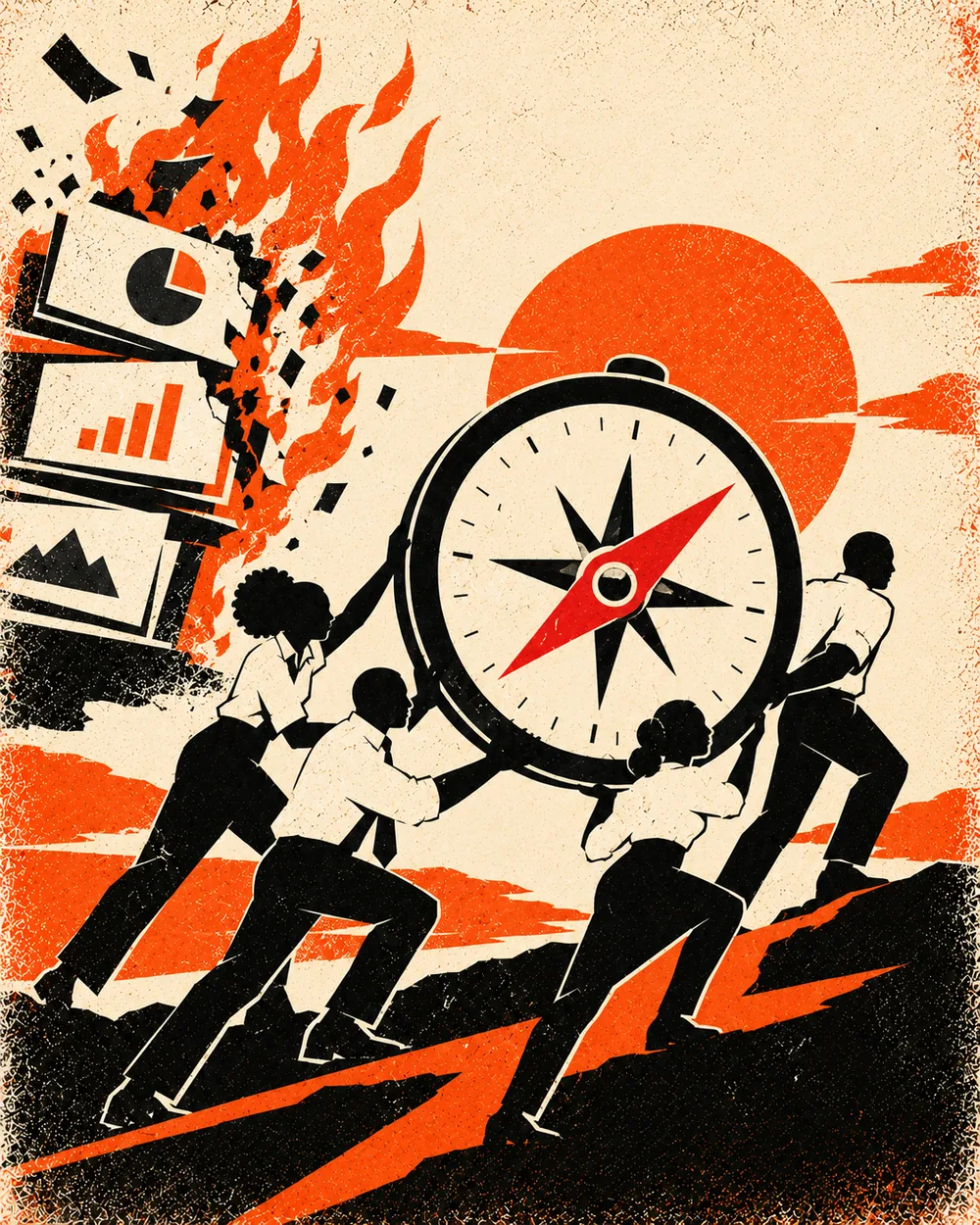
A product vision can look incredible in a deck and disappear the moment the meeting ends. The pictures are right. The future state is exciting. Leadership nods. The file gets saved somewhere important. Three months later, teams make decisions that have almost nothing to do with it.
That is not necessarily a presentation problem. The vision may still be trapped inside the artifact.
The artifact is not the vision
A deck can represent a vision. A prototype can represent a vision. A narrative can represent a vision. A strategy document can represent a vision. None of those artifacts is the thing itself.
A product vision can live in this weird perpetual quantum superposition where it is real and not real at the same time. It exists in the deck. It exists in the strategy. It exists in the leader’s head. People may even repeat the language back to you. But does it actually exist in the organization? That is harder to know.
The only way to really find out is through the observer effect. Remove the thing that is holding it in place. Close the deck. Leave the room.
If the artifact disappeared, would the vision persist? Is it still alive?
Would people still be able to explain the future you are trying to create? Would they still make different choices because of it? Would the idea keep moving when the original author was no longer there to translate it? That is the test.
A vision can be documented long before it becomes operationally real. You find out what state it is actually in by observing what survives without the artifact.
Start with current truth
Vision gets weak when it begins with aspiration and skips diagnosis. “Seamless.” “Intelligent.” “One experience.” “Personalized.” Those words can describe almost any future.
A useful vision starts by making the present legible. What is true today? Why is that condition insufficient? What happens to customers, employees, economics, operations, or the business if nothing changes? Then the future has tension. It is not a mood board. It is a response to a condition the organization understands.
The future should imply choices
I care less about whether everyone remembers the exact vision sentence than whether the vision changes decisions. A future state should help answer questions like: Do we build another local application or invest in shared capabilities? Do we optimize one workflow or connect the experience across the journey? Do we treat this metric as a reporting number or as an operating signal? Do we fund another exception or strengthen the common system?
If the vision cannot discriminate among options, it may be inspirational but not operational. The strongest vision work creates a direction that teams can use when the leader is gone.
A vision has to travel
The harder test comes after the original storyteller is no longer the one explaining it. It is one thing for the person who created the vision to explain it well. They know the history. They know the tradeoffs. They know which parts are essential and which parts are flexible. They can answer questions in real time and correct misunderstandings before they spread.
The real test is what happens when other people have to carry it. Can a product manager explain the future without flattening it into a feature list? Can an engineering leader make a tradeoff without accidentally breaking the underlying intent? Can an operations partner explain why the change matters in terms that make sense to their organization? Can someone challenge a request because it moves the company away from the intended future, even when the person who created the vision is not there?
That is when the vision starts becoming more than communication. It starts becoming part of how the organization makes decisions.
Vision needs carriers
Leaders often focus on the artifact because it is visible. The less visible work is developing carriers: people who can explain the current truth, people who understand why the future matters, people who know the important choices underneath it, and people who can translate the vision into their part of the system without shrinking it into their local roadmap.
You also need people who can challenge a new request by asking whether it moves toward or away from the intended future. That is how a vision becomes organizational capability instead of executive media.
The artifact still matters
None of this means the deck is unimportant. The deck matters if it helps people see the same future. The prototype matters if it makes an abstract idea concrete. The narrative matters if it helps someone understand the problem differently. The diagram matters if it makes the system easier to reason about. A good artifact can make a future easier to understand, easier to challenge, and easier to invest in. That is real work.
The problem starts when the artifact is mistaken for proof that the vision has landed. You can have a beautiful presentation and still have no shared direction. You can have a rough sketch and a room full of people making better decisions because they understand what it means. The production quality is not the test. The behavior that follows is.
AI makes this easier and more dangerous
AI can now generate polished visions faster than ever. You can create a prototype, strategy narrative, future state visualization, video, diagram, or interactive concept in a fraction of the time it used to take. That is useful. It also makes it easier to create the appearance of clarity before the thinking underneath it is mature. A polished artifact can make an idea feel more resolved than it actually is.
So the standard has to stay higher than the presentation. What is true today? Why is that not enough? What future are we choosing? What tradeoffs does that future imply? What decisions should become easier because of it? Who can explain it when you are not there? Those questions matter more as the cost of creating impressive artifacts keeps falling.
Make the vision survive you
The goal of vision is not to make people remember the slide. It is to create enough shared understanding of a desirable future that decisions begin to cohere around it. The deck matters if it helps. The prototype matters if it helps. The story matters if it helps.
Then the real test begins. Close the file. Leave the room. Watch what other people do.
If the vision is still shaping decisions, then it is alive. And if it disappears the moment the artifact does, you learned something important too.